
Debunking Myths & Savoring the Nectar of Frozen Grapes.
A picture is worth a thousand words, and the cover image of an Eiswein bottle nestled between a Beerenauslese and a Trockenbeerenauslese tells a rich story of craftsmanship, patience, and nature’s artistry. These three noble expressions of sweet wine share a lineage of late-harvest dedication, yet Eiswein stands apart—not touched by noble rot like its companions, but rather sculpted by winter’s chill.
While Beerenauslese and Trockenbeerenauslese rely on botrytis to concentrate their sugars, Eiswein remains pure, its intensity derived from frozen grapes pressed at the peak of winter. Yet despite its unique identity, a growing misconception persists: that Eiswein is a Canadian invention, with Germany merely adopting the process. Let’s set the record straight and dive into the true origins of this winter-born nectar.

The True Origins of Eiswein
The origins of Eiswein trace back to 1794 in Franconia, Germany, where an unexpected frost forced winemakers to either discard their frozen grapes or attempt vinification. Upon pressing, they discovered that the juice was intensely concentrated, yielding an extraordinary wine unlike anything they had produced before. This discovery led to a centuries-old tradition that remains one of the most challenging and rewarding styles of winemaking.
While Germany pioneered this technique, Eiswein gained widespread acclaim in Canada, particularly in Ontario’s Niagara Peninsula, where conditions reliably produce ice wine nearly every year. However, Canada only became a major player in ice wine production in the 1970s, nearly two centuries after Germany’s initial discovery. The difference in spelling—Eiswein in Germany and ice wine in Canada—is simply a linguistic distinction rather than evidence of borrowed tradition.
The Labor-Intensive Process of Eiswein
Eiswein production requires an unwavering commitment to nature’s whims. Unlike late-harvest wines, Eiswein grapes must remain on the vine until temperatures plummet to at least -7°C (19°F), though some regions wait for even lower temperatures to intensify the concentration. These frozen grapes are harvested in the dead of night or early morning to prevent any thawing, then pressed while still frozen, ensuring that only the highly concentrated sugars and acids make it into the juice while the water content remains behind as ice crystals. The result? A vibrant, intensely sweet wine with electric acidity to balance its lusciousness.
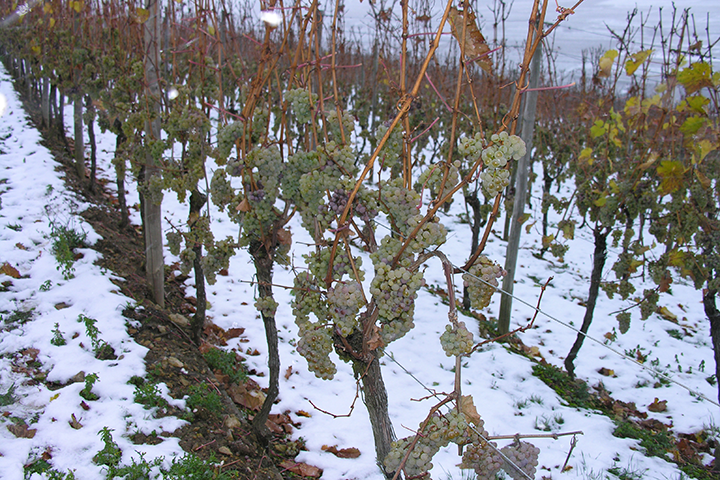
Unlike noble rot-affected dessert wines, such as Sauternes or Tokaji, Eiswein grapes remain healthy and free from botrytis, preserving the purity of fruit flavors—think crisp apple, pear, and citrus with an elegant minerality.
Cutting Corners: Cryoextraction & the Question of Authenticity
Given the extreme conditions required to produce Eiswein, some producers resort to cryoextraction—artificially freezing grapes post-harvest to mimic the natural process. While this method may yield a similar concentration of sugars, it lacks the unpredictable magic of naturally frozen grapes, often resulting in wines that feel more syrupy than vibrantly fresh. Authentic Eiswein or ice wine will always indicate its natural freezing process on the label, while cryoextracted versions are often labeled as “iced wine” rather than true ice wine.
Here’s to nature’s frozen gift, a testament to patience, precision, and the sweet rewards of time. May its golden nectar remind us that the best things in life come to those who wait. Prost!
Gregory Dean, SOMM&SOMM
Expressions of Eiswein: Terroir & Styles
While Eiswein shares a common production method, regional differences bring unique expressions to the table:
- Germany & Austria – The classic home of Eiswein, primarily made from Riesling, Gewürztraminer, or Grüner Veltliner. German Eiswein often showcases piercing acidity, honeyed stone fruit, and a crystalline minerality.
- Canada (Niagara & British Columbia) – Canadian ice wines are dominated by Vidal Blanc, a hardy hybrid grape, as well as Riesling and Cabernet Franc. These wines often lean into tropical fruit flavors like mango, lychee, and pineapple.
- United States (New York & Michigan) – Following the Canadian model, ice wine production here is small-scale but often impressive, featuring Vidal Blanc and Riesling.
Pairing & Enjoying Eiswein
A great Eiswein is a marvel of balance—its dazzling acidity prevents it from becoming cloying, making it a versatile companion to food. Here are some top pairing suggestions:
- Blue Cheese & Pâté – The intense sweetness of Eiswein counterbalances the salty, umami richness of blue cheese or foie gras.
- Spicy Asian Cuisine – Thai dishes, Szechuan flavors, or Indian curries contrast beautifully with the wine’s sweetness and acidity.
- Fruit-Based Desserts – Apple tarts, poached pears, and citrus-infused desserts enhance the natural fruit notes in the wine.
- Simple Sipping – Sometimes, Eiswein is best savored on its own, slightly chilled (about 8–10°C / 46–50°F), allowing its complexity to unfold slowly.
A Testament to Patience & Nature’s Gifts
Eiswein is one of the most challenging wines to produce, requiring patience, resilience, and a deep trust in nature. While Canada has mastered the art of ice wine production, Germany’s Franconian winemakers laid the foundation for this painstakingly crafted style centuries ago. Next time you sip a glass of this liquid gold, remember the dedication that went into each drop and savor the harmony of nature’s frozen masterpiece.
Prost 🍷


We welcome feedback…