Category: Tasting Insights

  • Perfect Pairings: Gewürztraminer w/Sweet and Sour Chicken

    Perfect Pairings: Gewürztraminer w/Sweet and Sour Chicken

    With so many variations of Asian cuisine, there isn’t a one-glass-fits-all wine. In fact, there are several perfect pairings within this gastro-genre. Alsace Gewürztraminer and the westernized Cantonese Sweet and Sour Chicken dish breaks the “if it grows together, it goes together” basic rule of food and wine pairing. It is important to note that not all Gewürztraminer wines will work in this scenario.

    Gewürztraminer from Alsace, France

    The Gewürztraminer wines of Alsace tend to be off-dry. Gewürztraminer from other regions can be sweeter with Riesling-like characteristics.

    No, I am not really comparing Riesling to Gewürztraminer 😉 There are, however, certain characteristics unique to Alsace Gewürztraminer making it the right choice for this dish.

    So… why does this pairing work so well? Dry, fruity and spicy version of this varietal stand up perfectly to the bold intense flavors of this dish.

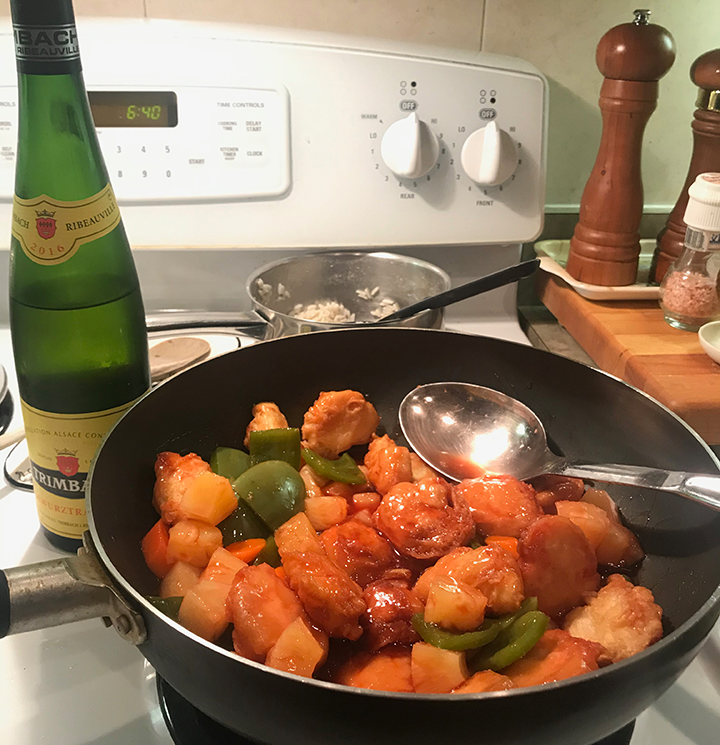
    Trimbach Gewürztraminer 2016 – Alsace, France

    Heat up the wok, chill the wine, and lets get started…

    Tammy’s Sweet and Sour Chicken

    2 Green Peppers

    2 Tomatoes

    2 Carrots

    Chicken Breasts (1 per person)

    3-4 Green Onions

    1 Small Can of Pineapple Chunks

    Prepare the batter (ingredients and instructions below). Cut the chicken breasts into small bite-size pieces. Cut vegetables and tomatoes (technically not a vegetable) into bite-size chunks. Blanch the carrots and green peppers and set aside for later. Batter the chicken pieces and deep fry in hot oil until golden brown. Prepare the sauce (ingredients and instructions below).

    Add blanched vegetables, tomatoes, and golden-fried chicken to the thickened sauce (make sure to add the chicken last). Heat thoroughly and serve.

    Open the wine and enjoy! 

    Batter

    1 Egg

    1 Cup Flour

    1/2 Cup Cornstarch

    6 tbsp Cooking Oil

    1 Cup + 2 tbsp Very Cold Water

    1 tsp Baking Powder

    1/2 tsp Salt

    Dash of Pepper

    Mix all of the dry ingredients, and add the liquids. Optional: Add a few drops of yellow food coloring.

    Sauce

    3/4 Cup Water

    1/4 Cup Pineapple Juice

    5 tbsp Sugar

    3 tbsp Vinegar

    1 tbsp Soy Sauce

    1 tbsp Ketchup

    3 tsp Cornstarch + 2 tbsp Water (Mixed into a Paste)

    In a saucepan, whisk all of the ingredients together except the cornstarch paste. Bring to a boil. Add cornstarch paste to thicken.

  • Perfect Pairings: Melon de Bourgogne w/Fettuccini With Clams and Dill

    Perfect Pairings: Melon de Bourgogne w/Fettuccini With Clams and Dill

    Every now and then you run across a food and wine pairing that is so perfect, you can’t imagine anything better. This is one of those rare instances when the wine ‘contrasts’ and at the same time ‘compliments’ the dish. Coastal region wines naturally pair with seafood. This is no exception. Melon de Bourgogne is the most widely planted grape in the Loire Valley, and the best comes from the AOP Muscadet Sèvre et Maine. After first tasting this wine, I thought how amazing it would be with a plate of fresh oysters. But that would be cliché 😉

    Domaine Claude Branger Muscadet Sevré et Maine
    Sur Lie Terroir Les Gras Moutons 2018

    Why is this a perfect pairing?

    The natural saltiness of the clams provide great contrast to the acidity of this wine. There are crisp spice and citrus zest notes in the wine that compliments the fresh creamy sauce in the dish.

    This wine spends a minimum of 24 months on the lees (sur lie), bringing a welcome yeasty aroma and flavor to the wine.

    Domaine Claude Branger Muscadet Sevre-et-Maine Sur Lie Terroir Les Gras Moutons 2018 – Melon de Bourgogne from Pays Nantais, Loire, France

    We first purchased the wine as part of our ongoing commitment to immerse ourselves in the various countries and regions during our sommelier studies. I was fortunate to discover this recipe in a 2014 online article by J. Gwendolynne Berry in the Palm Beach Post, while searching for others’ experiences and recommendation of food to pair with this specific wine.

    Fettuccini With Clams and Dill

    Original Recipe: FOOD & WINE Annual Cookbook 2012

    2 1/2 Pounds Clams

    1/2 Cup Dry White Wine

    2 Dill Sprigs (plus 1 tablespoon chopped dill (garnish))

    1/4 Cup Dry Vermouth

    3/4 Cup Sour Cream

    1 Small Clove Garlic

    1/4 Cup Chopped Onion

    1 Teaspoon Finely Grated Lemon Zest

    1 Teaspoon Finely Grated Grapefruit Zest

    1 Pound Fresh Fettuccine

    Freshly ground pepper

    The first step is to cook the clams. Make sure to rinse them well to remove any sand and dirt from the shells. Place the wine, clams, dill, and a few splashes of dry vermouth (approx. 2 tablespoons) in a large sauce pot. Bring to a boil. Cover and steam the clams until they open. Remove the clams, and place them into a bowl. Be sure to toss out any unopened clams. Strain the liquid and rinse out the pot. Return the liquid to the sauce pot.

    Simmer to reduce the liquid to about 1 cup. This should take between 8-10 minutes. Remove from heat add onions, garlic, citrus zest (lemon and grapefruit), and sour cream.

    Cook the pasta in a large pot of boiling and salted water. Be careful not to overcook the pasta. Just before the pasta reaches al dente, strain the water and add the pasta to the sauce pot. Add the remaining vermouth. Cook until the sauce is creamy. This should take about 6-8 minutes.

    Serve the pasta topped with clams.

    Enjoy!

    References

    Berry, J. (2014, June 11). Amid summer whites, a surprisingly creamy Vinho Verde. Retrieved October 06, 2020, from https://www.palmbeachpost.com/article/20140610/ENTERTAINMENT/812033625

  • Enthusiast to Sommelier: For the Sake of Learning

    Enthusiast to Sommelier: For the Sake of Learning

    There are a few (ok… many) wines described in the various books and study materials quickly finding their way to the top of my “must try” list. I blame it, among other things, on the alluring descriptions of “Wines to Know” in The Wine Bible by Karen MacNeil. Her words spark a curiosity quenched only by experiencing the wine(s) for yourself. So, we did. After reading her brilliant insight on Chile, we thought the entire experience would be better if we could review the materials while drinking the ‘Wines to Know’–all for the sake of learning.

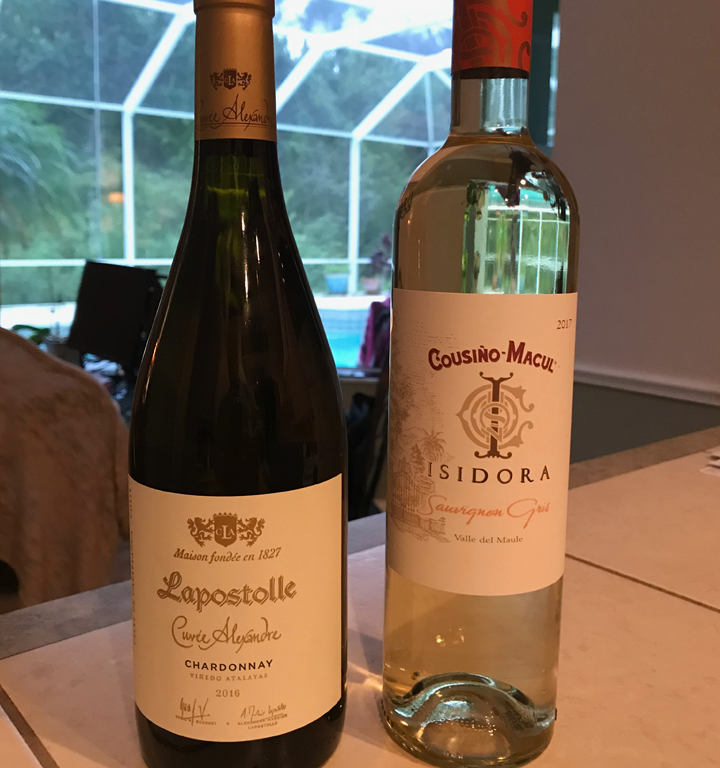
    Corkscrew-worthy whites from Chile:

    Lapostolle Cuvee Alexandre – Chardonnay (Casablanca Valley, Chile)

    Cousino-Macul Isidora – Sauvignon Gris (Maipo Valley, Chile)

    Karen MacNeil’s insightful book has really helped make sense of lesser-known wine regions, while adding context and detail to the mainstream regions (i.e. France, Italy, Spain, etc.). The other learning materials were no less responsible for inspiring late-night wine purchases. The Introductory Course & Exam Workbook, for example, provides the just enough of a description to peak one’s curiosity. While it’s always fun… err… educational to compare varietals from different regions, the styles and indigenous grape varieties were the ones to try—for the sake of learning 😉

    Corkscrew-worthy reds from Italy:

    Tormaresca Bocca di Lupo – Aglianico (Puglia, Italy)

    Santadi Terre Brune Carignano del Sulcis Superiore – Carignan (Sardinia, Italy)

    Somehow, consuming wine while studying for a wine exam just feels right. Moreover, drinking a Chilean white while being introduced to Chilean culture through the words of Karen MacNeil seems perfect. Kevin Zraly ends each section of his book, Windows of the World – Complete Wine Course, with wine tasting recommendations to compliment (and add context) to the corresponding chapter. So whether you choose to have the real-time experience of the sip-while-studying method or the reward-yourself-at-the-end-of-each-section approach, don’t think twice. It is after all… for the sake of learning.

    Back to the books!

    Next article in the series: Enthusiast to Sommelier: Take a Pass

    First article in this series: Enthusiast to Sommelier: Getting Started

  • Enthusiast to Sommelier: Sip, Sip Hurrah

    Enthusiast to Sommelier: Sip, Sip Hurrah

    The Court of Master Sommelier Deductive Tasting Method is at the heart of the two-day course and final exam. For level one certification, the curriculum in 2020 includes six (6) individual wine tastings designed to teach this very effective process for identifying wines. I’ve been preparing for this all of my adult life (ok… maybe even a little before), so how difficult can it be?

    Swirl, sip, swish and spit. Repeat. Using the correct terminology, describe the color. Is it purple, ruby or garnet? Neither… it is red (as indicated on the bottle). Specifically, it is the color of a horse barn I remember from my childhood. Slightly faded, a little weathered, but still… red. Do I notice any secondary colors? That depends. Does adding an adjective to my description qualify as a ‘secondary color?’ No. So… bright red or intense red isn’t considered secondary colors? No. Secondary colors to look for in red wine are ruby, garnet, orange, brown and blue.

    While we all have our unique–almost Shakespearean–ways to describe the characteristics of wine. It is important to learn the universal terminology. In fact, it’s a requirement. Instead of describing the smell of certain Bordeaux wines in the tasting rotation as something I remember from that horse barn, I need to call-out the presence of brettanomyces.

    The entire premise of the Deductive Tasting Method is to use all of the information gathered from sight, smell and taste to determine a wine’s origin. This includes everything from varietal to vintage. It is a structured (and proven) process to quickly and accurately analyze wine. If nothing else, it adds another reason–albeit scientific–to open more wine. I might need another corkscrew 😉

    Back to the books.

    Next article in the series: Enthusiast to Sommelier: Right on Cue

    First article in this series: Enthusiast to Sommelier: Getting Started

  • Learning To Recognize The Aromas of Wine

    Learning To Recognize The Aromas of Wine

    Swirl and sniff swirl and sniff. What do you smell? The buzz words I hear are, fruit, floral, tobacco. Flint. What do you think of when someone says, I smell floral notes? I think, what do you mean, are you smelling roses, jasmine, carnations? Fruit…..black fruit or red fruit? Are we talking red apples here, strawberries, or raspberries? They all smell different, so what exactly are you trying to say? Currants, how many times have you heard, I smell currants. Quite frankly, I have never smelled a currant so how do I know what a currant smells like. Tobacco…what does that mean? A dirty ashtray, a pipe, tobacco growing in a field? Flint, what in the world does flint smell like?

    I can only imagine what comes next.