
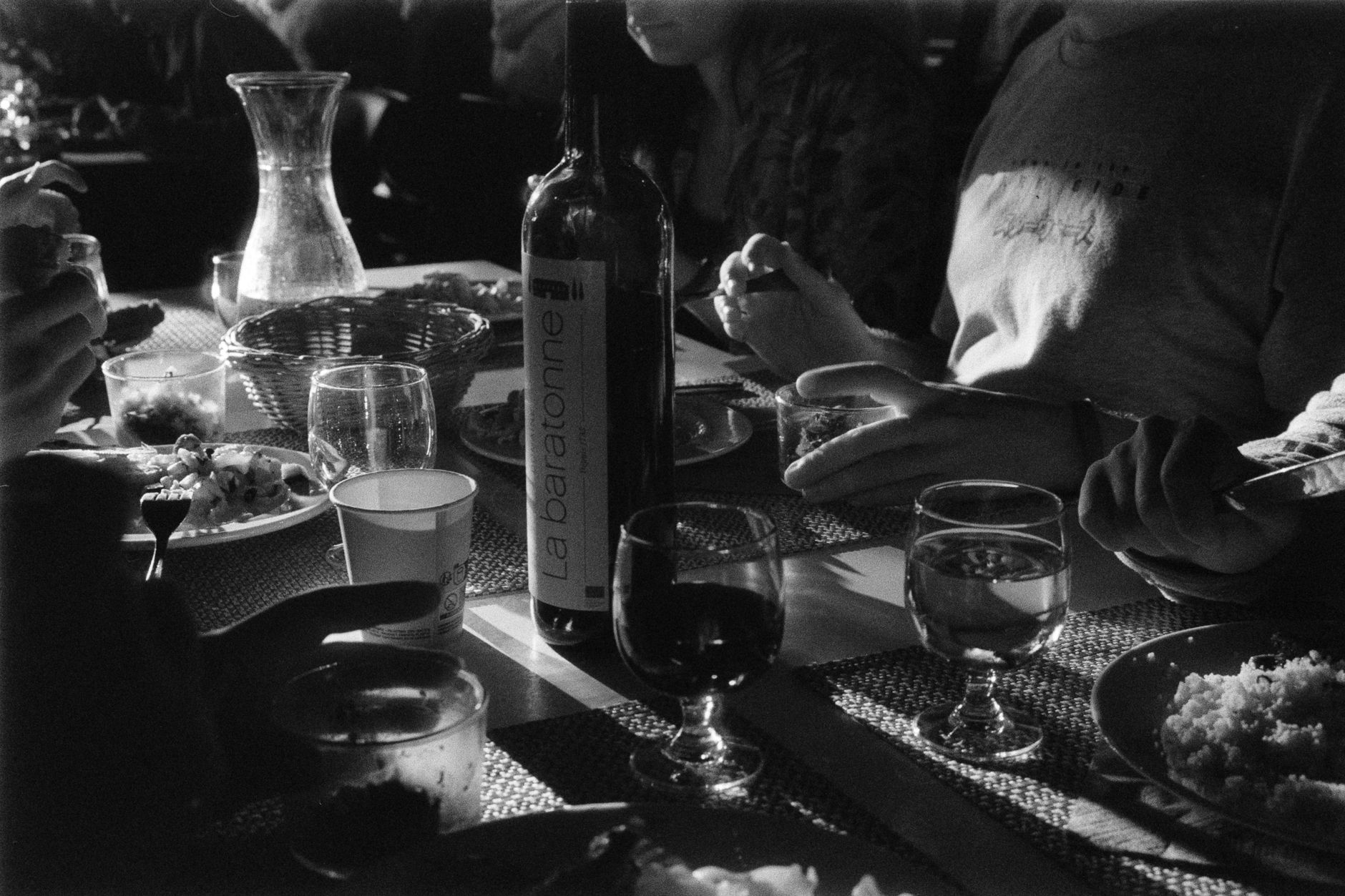
Wine, People & the Etiquette of Enjoyment.
There is something wonderfully social about wine. It has a way of turning an ordinary evening into an occasion, whether that occasion is an elaborate dinner in a fine restaurant, a tasting at a neighborhood wine shop, a visit to a vineyard, or a handful of friends gathered around a kitchen table with a few bottles and something good to eat.
The setting may change, as does the level of formality, but the appeal is remarkably consistent. We gather around wine because it gives us something to explore and something to talk about. It introduces us to places we’ve never visited, grapes we may never have encountered, producers whose stories are worth knowing, and foods that somehow taste a little different when accompanied by the right bottle. Perhaps most importantly, wine gives us a reason to sit together long enough for conversation to develop.
That last part is easy to overlook.
Wine gatherings are, after all, social occasions. We aren’t simply there to taste. We’re there to meet people, reconnect with friends, share a meal, celebrate something, learn something, or simply enjoy an evening together. Good wine etiquette, therefore, isn’t about imposing a set of rigid rules on the experience. It is really about understanding what kind of gathering we’re attending and being considerate of the people who have helped create it.

Every Wine Gathering Has Its Own Rhythm
A classic wine tasting tends to be focused on the wine itself. Perhaps a sommelier, winemaker, educator, or knowledgeable enthusiast has assembled a flight around a particular region, grape, vintage, or style. There may be tasting notes, maps, background information, and plenty of questions.
In that setting, listening is part of participating. If someone has spent time preparing the tasting, researching the wines, and creating a narrative around them, it is reasonable to give that person your attention while they introduce each bottle. There is no expectation that everyone sit silently as though attending a university lecture, but carrying on a completely unrelated conversation while someone is explaining the wine defeats much of the purpose of being there.

A wine dinner has a different rhythm. Now the food becomes an equal partner, and the experience is as much about the interaction between the wine and the dish as it is about either one individually. The chef may explain the inspiration behind a course while the sommelier explains the wine selected to accompany it. Guests taste, compare, discuss, and eventually wander into conversations of their own.
That’s exactly what should happen.
The same is true of a winery visit, where the landscape, history, vineyard, cellar, and people behind the wine become part of the experience. At a retail tasting, the atmosphere may be considerably more casual, but there is still usually someone who has invested time and expertise into presenting the wines. Even a large public wine festival has its own etiquette: give the person pouring a chance to explain the wine, avoid monopolizing the table when others are waiting, and remember that a tasting is an opportunity to explore rather than an endurance contest.
The details change, but the underlying courtesy remains surprisingly consistent.

The Most Important Person in the Room May Be Holding the Bottle
There is a particularly interesting dynamic in a private tasting among friends.
Perhaps ten people have gathered around a table, each assigned a wine from a particular country or region. Everyone has been encouraged to do a little homework before arriving. One person has researched the history of the appellation. Another has discovered an indigenous grape that most of the group has never tasted. Someone else knows the producer’s story or has uncovered an unusual connection between the wine and the evening’s cuisine.
When that bottle arrives, the person who brought it isn’t simply opening a bottle. They are bringing a little piece of their research to the table.
That deserves a moment of attention.
It doesn’t have to become a formal presentation, and nobody wants to turn a dinner among friends into a series of ten lectures. In fact, one of the pleasures of these gatherings is that the information is delivered conversationally. A few minutes about the region, the grape, the producer, or the reason the bottle was selected may be all that is necessary to get everyone thinking about what’s in the glass.
But while that person is sharing, the rest of the table has a simple responsibility: listen.
The person holding the bottle has, for those few minutes, the floor.
Put the side conversation on pause. Look up from the plate. Give them a chance to tell the story they’ve brought with the wine. If something sparks a question, ask it. If someone else knows something that adds to the discussion, that’s even better.
Then taste the wine and let the conversation evolve.
It’s a small courtesy, but it changes the experience considerably for the person who has taken the time to prepare.

Wine Education Should Create Curiosity, Not Competition
One of the wonderful things about wine is that there is always more to learn. That is also one of the things that can make wine conversations a little tricky.
Wine attracts knowledgeable people, and knowledgeable people naturally enjoy sharing what they know. But there is a meaningful difference between contributing knowledge and demonstrating knowledge.
If someone mispronounces a grape, there may be a gentle way to help them. If someone has a different impression of a wine, that doesn’t necessarily mean they’re wrong. If someone discovers something about a region that you already knew, you don’t have to establish that you knew it first.
The most enjoyable wine conversations tend to be collaborative. One person’s knowledge sparks another person’s question, which leads someone else to share an experience, which sends the group in an entirely new direction.
That is how a tasting becomes a conversation.
Wine doesn’t need to become a competition over who knows the most. There is plenty of room around the table for the enthusiast who has been studying wine for twenty years and the person who has just discovered that they really like Riesling.
In fact, the latter may ask the more interesting question.

There Is No Shame in Not Liking the Wine
Another important piece of wine etiquette is allowing people to have their own palates.
Not every wine will appeal to everyone. That’s not a failure of the wine, the winemaker, or the person who brought it. It’s one of the reasons tasting a group of wines together is so interesting.
Perhaps one person finds a wine beautifully restrained while another thinks it lacks character. One guest loves the acidity while another prefers something rounder and richer. Someone detects cherries, another gets herbs, and a third person can’t identify anything beyond “wine.”
All three experiences are legitimate.
A useful wine gathering doesn’t require consensus. It encourages people to articulate what they are experiencing and, perhaps more importantly, to be curious about why someone else is experiencing something different.
There is a world of difference between saying, “I don’t care for this style,” and announcing that a wine is objectively terrible. The first tells us something interesting about the person tasting it. The second tends to end the conversation.
And conversation is what we’re really after.

The Informal Gathering Is Still Worth Protecting
Perhaps the easiest wine gathering to underestimate is the one that happens among friends.
There is no admission fee. Nobody is taking notes. There may not even be a corkscrew within reach when the first bottle arrives. Dinner might be beautifully prepared or ordered from the local restaurant. Someone will inevitably arrive late, someone will forget what they were supposed to bring, and at some point the conversation will wander so far from wine that nobody will remember what region we’re supposedly exploring.
That’s not a problem.
It’s part of the charm.
But informality doesn’t mean that the wine becomes irrelevant. In fact, these relaxed gatherings can be among the best opportunities to learn because there is no pressure to perform. We can ask basic questions without feeling foolish. We can disagree without worrying about being judged. We can admit that we’ve never heard of a grape, taste something completely unfamiliar, and discover that we love it.
What makes these evenings special is the balance between structure and spontaneity.
At the beginning of the evening, when a bottle is being introduced, it is worth giving the presenter everyone’s attention. Once the wine has been poured and discussed, let the evening take over. Talk about the wine. Talk about the food. Tell stories. Laugh. Drift into subjects that have nothing whatsoever to do with wine.
The conversation eventually becoming less structured isn’t evidence that the evening has failed.
It may be evidence that it has succeeded.

The Art of Reading the Room
Perhaps the most useful rule of wine etiquette is one that doesn’t appear on many tasting guides: read the room.
A sommelier leading a formal tasting may expect everyone’s attention for several minutes at a time. A winemaker visiting a small group may want to engage in a deeper discussion. A casual wine-shop tasting may be designed primarily for people to mingle.
The same behavior that would be perfectly appropriate in one setting could feel awkward in another.
Good hosts understand this, and good guests do too.
If people are deeply engaged in the wine discussion, let it continue. If someone is clearly telling an important story, listen. If the table has reached the point where everyone is simply enjoying dinner and conversation, there may be no reason to force everyone back into tasting mode.
Wine education works best when people want to participate.
The objective isn’t to extract every possible fact from a bottle before anyone is allowed to talk about anything else. It is to give people enough context to make the experience richer.

And Then There Is the Phone
There is, of course, one modern exception to the general rule about paying attention.
If someone mentions a grape you’ve never heard of and you immediately reach for your phone to find out what it is, that’s probably a good thing.
If someone is discussing the elevation of a vineyard and you want to look it up, go ahead.
If you’re trying to settle whether a particular appellation is spelled with one “n” or two, we’re happy to let Google referee.
But if someone is sharing the story behind a bottle while the rest of the table watches a phone screen, something has gone wrong.
One of the great luxuries of a wine gathering is that we have chosen to be together in the same physical place. The internet will still be there later.
The people around the table may not always be.

Ultimately, It Is About Generosity
The best wine gatherings have a certain generosity about them.
The host generously opens the home.
The cook generously prepares the meal.
The person who brings the wine generously shares something they have selected.
The presenter generously shares what they have learned.
And the guests generously give their attention, their questions, their observations, and their enthusiasm.
That reciprocity is really the heart of wine etiquette.
It isn’t about knowing which fork to use or whether your glass is being held correctly. It isn’t about memorizing a list of rules or making everyone behave like they’re attending a professional tasting.
It is simply about recognizing what someone else has contributed to the experience and giving it the consideration it deserves.
When someone is pouring, listen.
When someone has prepared a story, let them tell it.
When someone has a different opinion, be curious.
When the formal part of the evening is over, relax and enjoy the company.
And when the conversation eventually wanders away from wine—which it almost certainly will—don’t worry about it. Good wine has a habit of doing that. It opens the door, gets everyone seated around the same table, and then quietly steps aside while people begin talking about their lives.
That’s perhaps the greatest thing about wine.
We may gather because of the bottle, but we stay because of the people.
And if, somewhere along the way, we learn something new about a grape, a region, a dish, or one another, then the evening has given us exactly what we came for.
Wine brings us to the table. Good company gives us a reason to stay.
Cheers 🍷
Cover Photo by Bingqian Li on Pexels.com









You must be logged in to post a comment.