Tag: #sommlife

  • The Rum Renaissance

    The Rum Renaissance

    Terroir, Tradition, and Tiki.

    Welcome to the Rum Renaissance. For years, rum stood in the shadow of whiskey and tequila—either trapped in syrupy cola combos or buried in blender drinks at beach resorts. But no more. Rum is having a moment. A big one. We are in the midst of a Rum Renaissance, where the world is finally recognizing what islanders, pirates, distillers, and cocktail aficionados have known all along: rum is wildly complex, deeply traditional, and incredibly expressive of terroir.

    From the agricole fields of Martinique to the molasses stills of Barbados, from navy-style overproofs to funky pot-stilled hogo bombs from Jamaica, rum is rewriting its story. And we’re drinking it all in—neat, stirred, shaken, and smoked.

    Photo by Alex P on Pexels.com

    Terroir in a Glass

    Unlike other spirits, rum can be made anywhere sugarcane grows—and even where it doesn’t. This gives rum its greatest gift: variety. Each region has its own techniques, laws, traditions, and signature profiles. Let’s explore:

    1. Agricole Rhum (France’s Caribbean Legacy)

    • Where: Martinique, Guadeloupe
    • What: Made from fresh-pressed sugarcane juice, not molasses
    • Taste: Grassy, vegetal, earthy, often dry and structured

    Featured RumRhum J.M Blanc (Martinique)
    A pristine example of agricole: fresh cut grass, lime zest, sea spray.

    Pairing Idea:
    Ceviche with Coconut Cream and Cilantro
    The rhum’s herbal notes elevate the citrus and herbs; the coconut softens the sharper edges.

    2. English-Style Rums (Colonial Depth)

    • Where: Jamaica, Barbados, Guyana
    • What: Usually pot-stilled, molasses-based, deeply flavored
    • Taste: Bold, funky (think overripe banana, petrol, leather), spicy

    Featured RumSmith & Cross Traditional Jamaica Rum
    This overproof beast is unapologetically funky, rich with esters.

    Funky Kingston Daiquiri

    • 2 oz Smith & Cross
    • 0.75 oz fresh lime juice
    • 0.5 oz Demerara syrup (2:1)
      Shake hard, strain into coupe. Garnish with lime zest.

    Food Pairing:
    Jerk Chicken Tacos with Mango Salsa
    The spice loves the funk. The mango calms the heat.

    3. Spanish-Style Rums (Clean & Smooth)

    • Where: Cuba, Panama, Nicaragua, Dominican Republic
    • What: Column-distilled, molasses-based, often aged in solera systems
    • Taste: Round, vanilla-laced, approachable, sometimes sweetened

    Featured RumRon Diplomático Reserva Exclusiva (Venezuela)
    Creamy, dessert-like with notes of toffee, fig, and orange peel.

    Pairing Idea:
    Dark Chocolate Tart with Sea Salt & Orange Zest
    The rum mimics the dessert’s flavors and adds a silky finish.

    4. Navy & Overproof Rums (Bold & Historical)

    • Where: Blends from multiple islands
    • What: Strong, often high-proof, originally designed for sailors
    • Taste: Dark, molasses-heavy, burnt sugar, barrel spice

    Featured RumPusser’s British Navy Rum
    Historically the rum ration of the Royal Navy. Still punches at 54.5% ABV.

    Smoke & Oak

    A brooding, stirred rum cocktail that honors the dark, barrel-aged legacy of navy rums—perfect for sipping slowly alongside robust food.

    • 2 oz Pusser’s British Navy Rum
    • 0.5 oz Amaro Averna (or another herbal amaro)
    • 0.25 oz PX Sherry or sweet vermouth
    • 2 dashes Angostura bitters
    • Orange peel, for garnish
    • Optional: small puff of hickory smoke (if available, for presentation)

    Add all ingredients to a mixing glass with ice.

    Stir until well chilled and diluted (about 20–25 seconds).

    Strain into a rocks glass over a large cube.

    Express orange peel over the top, then garnish.

    Optional: briefly smoke the glass with hickory wood using a smoker lid or handheld gun before pouring.

    Why It Works:
    This stirred sipper keeps the boldness of Pusser’s but adds complexity and elegance through the herbal and dried fruit elements of the amaro and sherry. Think of it as a rum-based sibling of a Boulevardier or Old Fashioned—with nautical swagger.

    Pairing:
    Spiced Lamb Chops with Pomegranate Molasses
    The cocktail’s smoky, bitter-sweet balance cuts through the rich lamb and enhances the molasses glaze with dark fruit undertones.

    Photo by Augustinus Martinus Noppu00e9 on Pexels.com

    Tiki: The Theatrical Resurgence

    Tiki is more than flaming pineapples and plastic leis. It’s a deep, post-Prohibition movement rooted in escapism and complex cocktail craft. Rum is its lifeblood.

    Classic Tiki:

    The Mai Tai (Trader Vic Style)

    • 1 oz aged Jamaican rum
    • 1 oz Martinique rhum agricole
    • 0.75 oz lime juice
    • 0.5 oz dry curaçao
    • 0.25 oz orgeat
      Shake and serve over crushed ice in a rocks glass with a spent lime shell and mint.

    Pairing:
    Pork Belly Bao Buns with Pickled Pineapple Slaw
    The rich meat loves the bright citrus and almond note of the Mai Tai.

    Modern Tiki Twist:

    Banana Republic

    • 1.5 oz aged Guatemalan rum (like Ron Zacapa 23)
    • 0.5 oz Giffard Banane du Brésil
    • 0.5 oz lime juice
    • 0.25 oz cinnamon syrup
    • Dash chocolate bitters
      Shake, strain over large ice sphere. Garnish with brûléed banana slice.

    Pairing:
    Banana Leaf Steamed Snapper with Coconut Rice
    Rum’s sweet notes mirror the tropical dish while the acidity lifts the fatty fish.

    SOMM&SOMM Related Article: The Art of Island Cocktails

    Rum & Food Pairing Matrix

    Rum StyleFlavor NotesFood Pairing Idea
    AgricoleGrassy, herbal, earthyThai papaya salad, ceviche, goat cheese
    Jamaican Pot StillFunky, estery, boldJerk chicken, plantain chips, grilled pineapple
    Spanish SoleraCaramel, vanilla, light spiceChocolate desserts, roasted pork, flan
    Overproof NavyDark, molasses, high alcoholBarbecue brisket, sticky ribs, mole poblano
    Aged Caribbean BlendDried fruit, baking spiceDuck breast, spiced nuts, roasted squash

    🏴‍☠️ One Fact, One Fiction — You Decide Which is Which

    Rum is soaked in stories—some true, some twisted through time and tide. Here are two tales from the deep barrels of history and lore. One is factual. One is pure (delicious) fiction. Can you tell them apart?

    🗡️ Tale : The Cursed Cask of Port Royal
    In 1692, after a devastating earthquake sank much of Port Royal, Jamaica into the sea, divers later recovered an intact rum cask from the sunken taverns. Locals claimed anyone who drank from it was cursed with endless drunken visions of ghost pirates demanding “just one more pour.”

    🎖️ Tale : The Rum Ration that Sparked a Mutiny
    For over 300 years, British sailors received a daily ration of rum—until July 31, 1970, when the Royal Navy ended the tradition in what became known as Black Tot Day. Some sailors protested so fiercely that one destroyer’s crew reportedly staged a 24-hour “rum strike,” refusing orders until their drams were reinstated. They weren’t.

    Guess which one’s real? Which one’s rum-soaked legend? We’ll reveal the truth at the bottom of this article.

    End on a Sweet Note

    Cane & Cream

    • 1.5 oz El Dorado 12 Year
    • 0.5 oz Amaro Averna
    • 0.5 oz vanilla syrup
    • 1 oz heavy cream
      Shake hard with ice, strain into coupe. Top with shaved dark chocolate.

    Pairing:
    Rum-Soaked Tres Leches Cake
    The cocktail mirrors and magnifies the dessert while staying balanced.

    Drink Globally, Pair Locally

    To wines aged with wisdom, to rums kissed by the sea—
    May yer palate find treasure, and yer glass never be empty!
    Drink deep, me hearties, for the tannins be fair,
    And the finish be long as a siren’s stare!

    Captain Sommelier (Greg), Keeper of the Sacred Corkscrew 🏴‍☠️🍷

    The rum category is a playground of discovery. Whether you prefer the finesse of French agricole, the bombast of Jamaican funk, or the dessert-like smoothness of Spanish styles, there’s a rum—and a pairing—for you. Let this be your invitation to go beyond the Daiquiri (though that’s a perfect drink) and explore terroir, tradition, and tiki with every pour.

    Raise your glass to rum’s rebirth. And when you do—pair it with something unexpected. Something delicious. Something unforgettable. Cheers 🍹

    ✅ Truth Revealed: Tale is Fact!

    The Rum Ration that Sparked a Mutiny
    Yes, it’s true! For over three centuries, the British Royal Navy issued daily rum rations to sailors—a practice known as the “tot.” On July 31, 1970, the tradition ended, a day still remembered as Black Tot Day. Sailors wore black armbands, held mock funerals, and in some cases, even staged minor revolts or refused duties in protest of the decision. Though the rumored “rum strike” on a destroyer remains unconfirmed in official records, the outrage was real. Some sailors believed the end of the tot marked the decline of naval morale.

    ❌ Tale ? Pure Rum-Soaked Fiction.

    While Port Royal did sink into the sea during a catastrophic earthquake in 1692, and rum was certainly flowing in the taverns before it happened, no cursed cask has ever been recovered—and no spectral pirates have officially been reported demanding more pours (at least none soberly documented). But admit it: you wanted that one to be true, didn’t you? 😎

    #SommLife

    Cover Photo by Wolrider YURTSEVEN on Pexels.com

  • Old World Regions: Bordeaux

    Old World Regions: Bordeaux

    Bordeaux is a timeless elixir of history, terroir, and tradition. It’s a name that resonates with wine enthusiasts worldwide and is synonymous with excellence in winemaking. Nestled along the serene banks of the Garonne River in southwestern France, the Bordeaux wine region is a hallowed ground for cork dorks ;), boasting a rich history, distinct terroirs, and a complex classification system that sets it apart as one of the world’s foremost wine-producing regions.

    A Glimpse into Bordeaux’s Enigmatic Past

    Bordeaux’s history as a wine-producing region dates back to Roman times when the first vineyards were planted. However, it was during the 12th century, under the rule of Eleanor of Aquitaine and her marriage to Henry II of England, that Bordeaux wines gained international recognition. The English became avid consumers of Bordeaux wines, creating a demand that laid the foundation for Bordeaux’s global reputation.

    “…you are not to conclude I am a drinker. My measure is a perfectly sober 3 or 4 glasses at dinner, and not a drop at any other time. But as to those 3 or 4 glasses I am very fond.”

    Thomas Jefferson

    During the 17th century, Dutch engineers drained the marshlands and introduced a more systematic approach to winemaking, paving the way for Bordeaux’s vineyards to thrive. In the 18th century, Thomas Jefferson, the third President of the United States, became an ardent admirer of Bordeaux wines, further elevating their prestige. I had the opportunity several years ago to ogle over (look but don’t touch) two bottles from Jefferson’s collection. The bottles were locked inside a wire cage, covered in dust, each donning a small white price tag–$20,000. 

    Left Bank vs. Right Bank: A Tale of Two Terroirs

    One of the key distinctions in Bordeaux lies in its geographical diversity, which results in two distinct terroirs: the Left Bank and the Right Bank. Here is the breakdown…

    Left Bank

    – Located to the west of the Gironde Estuary and the Garonne River.

    – Predominantly features Cabernet Sauvignon as the dominant grape variety.

    – Famous appellations include the Médoc, Pauillac, Margaux, and Saint-Julien.

    – Produces wines known for their structured, tannic character and aging potential.

    Right Bank

    – Situated to the east of the Gironde Estuary and the Dordogne River.

    – Merlot is the primary grape variety, complemented by Cabernet Franc and sometimes Malbec.

    – Renowned appellations include Saint-Émilion and Pomerol.

    – Produces wines characterized by their elegance, supple texture, and approachability in their youth.

    Bordeaux Region in Southwest France

    Bordeaux’s Classifications: A Pyramid of Prestige

    Bordeaux boasts a complex classification system, which adds an extra layer of intrigue to its wines. The most famous classifications include:

    1. Bordeaux AOC:

       – The base level of classification, offering wines that showcase Bordeaux’s classic characteristics.

       – These wines can come from anywhere within the Bordeaux region and are typically approachable and affordable.

    2. Bordeaux Supérieur AOC:

       – A step above the Bordeaux AOC, with stricter quality control standards.

       – Often produced from older vines, resulting in more concentrated flavors.

    3. Médoc and Graves Classifications:

       – Within the Médoc and Graves regions, several châteaux are classified as Cru Bourgeois or Cru Artisan, signifying wines of consistently high quality.

    4. Saint-Émilion Classification:

       – Saint-Émilion has a unique classification system that is revised periodically.

       – It includes three main categories: Grand Cru Classé, Premier Grand Cru Classé “B,” and Premier Grand Cru Classé “A.”

       – These classifications indicate the quality and prestige of the wineries.

    5. 1855 Classification of the Médoc:

       – Arguably the most famous classification in Bordeaux, it was established for the Exposition Universelle de Paris.

       – Divided into five growths or “crus,” with the Premier Cru being the highest tier.

       – Châteaux such as Château Margaux and Château Latour hold this esteemed title.

    The complete list of all five first growths include:

    1. Château Latour
    2. Château Lafite Rothschild
    3. Château Margaux
    4. Château Haut Brion
    5. Château Mouton Rothschild

    Bordeaux’s intricate classification system reflects the region’s unwavering commitment to maintaining the quality and reputation of its wines.

    Bordeaux’s allure lies in its rich history, diverse terroirs, and complex classification system. Whether you’re sipping a bold Cabernet Sauvignon from the Left Bank or enjoying the velvety embrace of a Merlot-based wine from the Right Bank, Bordeaux offers a wine experience like no other. Its journey from ancient Roman vineyards to its present-day global prestige is a testament to the enduring artistry and craftsmanship of Bordeaux winemakers. With each bottle, Bordeaux encapsulates centuries of tradition, making it an enduring and timeless elixir for wine lovers around the world.

    Cheers 😉

  • Perfect Pairings: Semillón w/Pan-fried Cod and Lemon Dill Sauce

    Perfect Pairings: Semillón w/Pan-fried Cod and Lemon Dill Sauce

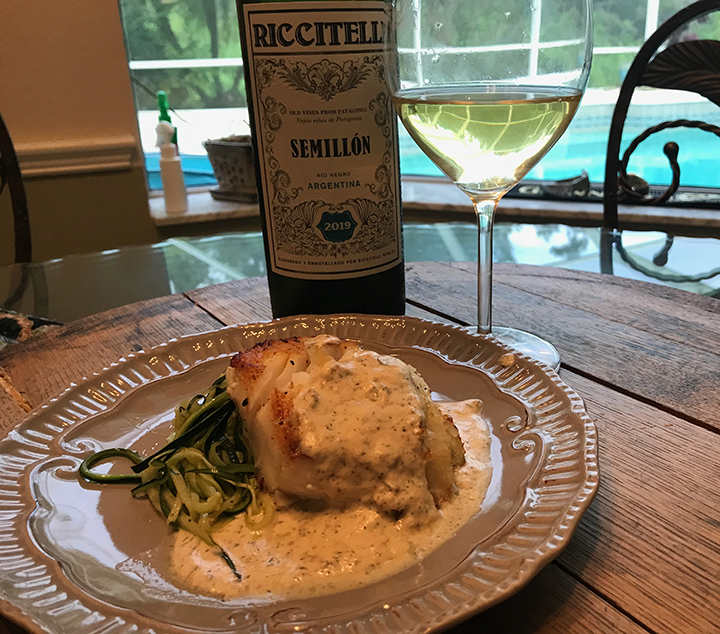
    Fish is versatile, but can quickly become boring and mundane. We eat fish often, and are always looking for ways to create dishes that connect interesting wines with fish-friendly herbs and spices. This particular dish–simple as it seems–was perfectly paired with an amazing old-vine Semillón from Patagonia, Argentina. Together, this fish dish and wine pairing was anything but ordinary.

    A side note…

    About a year ago, Tammy and I reluctantly subscribed to one of the mainstream meals-delivered-to-your-door services. At the time, it was the trend for busy individuals with little to no time for grocery shopping. While the idea of fresh fruit, vegetables and proteins delivered to your door sounded great, we quickly realized that the company we chose took very little care in how they packaged and shipped the products. We cancelled after the first delivery.

    Imagine our trepidation when presented with the opportunity to subscribe to a service that promised fresh caught salmon delivered monthly. Regardless, we decided to give it a try. The Wild Alaskan Company delivered on their promise of freshness, consistency and care. We highly recommend subscribing to this service. The fish in this recipe was from our subscription.

    Description

    There are many ways to prepare cod. The most popular being battered and fried into the pub-centric dish–fish and chips. Nothing like it 😉 When you’re looking to perfect date night dish, however, reach for the herbs, spices and of course… the wine! This dish could pair with other white wines–such as Chablis or Viognier–but the under-appreciated Semillón (Sémillon) grape makes for a perfect pairing.

    Sémillon shines alongside Sauvignon Blanc in the Bordeaux region of France. Lower percentages are used in the typical 80-20 white Bordeaux blends, but Sémillon is the star of the noble-rot nectar of Sauternes. The Sémillon grape in Argentina (referred to as Semillón) has characteristics unique to grapes grown in cooler climates and higher altitudes. With a higher acidity, natural lemon notes and noticeably longer finish, this wine is the perfect compliment to lighter fish dishes. The dill and lemon sauce bring it all together.

    Recipe

    2 Fillets of Cod (5-6 oz. each – Wild Alaskan Company)

    Salt and Pepper

    1 tbsp. Unsalted Butter

    Olive Oil

    Lemon Zest

    Juice from Half a Lemon

    1 tsp. Dried Dill

    1/4 Cup Chicken Broth

    1/2 Clove of Minced Garlic

    1/4 Cup Cream (I used Half and Half)

    Make sure to dry the fish fillets with a paper towel. This will ensure the fillets brown-up nicely in the pan. Sprinkle the fillets with salt and pepper.

    With the stove on medium heat, heat the butter and olive oil. Once the olive oil and butter are hot, place the fillets in the pan and cook for 4 minutes or so. We are trying to get a nice even golden sear. Carefully flip the fillets and cook the other side for an additional 4 minutes. Remove the fillets and set aside.

    Add the minced garlic to the pan and sauté for a minute. Turn the heat down slightly and add the cream, chicken broth and a dash of salt and pepper. Continue to simmer until the sauce thickens (usually 5 minutes). Add the lemon zest, lemon juice and dill.

    Plate it. Pour the wine and enjoy! We recommend a 2018 Matias Riccitelli Wines Old Vines Semillón