Tag: Martinis

  • The Martini is Having Another Moment (Again… But Differently)

    The Martini is Having Another Moment (Again… But Differently)

    The Martini never really disappears. It fades. It softens at the edges. It gets misunderstood, overbuilt, sweetened, dirtied, stripped down, and occasionally disrespected. But it never leaves. And then—quietly at first—it returns.

    A colder glass. A cleaner line. A more intentional pour.

    Another moment.

    But this time feels different.

    Because this Martini revival isn’t about rebellion or reinvention alone. It’s about reconciliation—between generations, between philosophies, and between what the Martini was… and what we now want it to be.

    Photo by Taryn Elliott on Pexels.com

    The Illusion of Simplicity

    The Martini is often described as simple: gin (or vodka), vermouth, and maybe a garnish.

    But simplicity, in this case, is a trap.

    Because every decision—spirit, ratio, temperature, dilution, garnish—is a statement. And right now, drinkers aren’t just ordering Martinis.

    They’re curating them.

    A 3:1 gin Martini with a lemon twist is not the same drink as a 50/50 with bianco vermouth and an olive.

    Not philosophically. Not culturally.

    And certainly not generationally.

    The Ghost of Martinis Past

    To understand why the Martini is having another moment, you have to understand the echoes behind it.

    The mid-century Martini—carried into cultural mythology by figures like James Bond—became a symbol of precision and control. Cold, dry, and decisive. Often vodka. Frequently shaken. Always intentional.

    Then came the unraveling.

    By the time Generation X took hold of cocktail culture, the Martini had loosened its definition entirely. It became a glass, not a recipe. Anything served “up” could wear the name: appletinis, chocolatetinis, espresso Martinis that leaned more dessert than discipline.

    And somewhere along the way, vermouth—the quiet architect of balance—was nearly erased.

    This is the version many Millennials inherited: a cocktail with a famous name and an identity crisis.

    Photo by Mary White-Cornell on Pexels.com

    The Return of the Ratio

    Here’s where things get interesting.

    The current Martini revival isn’t about going back to one “correct” version. It’s about rediscovering the importance of ratio.

    And that’s where generational influence quietly reshapes the glass.

    The Baby Boomers Influence: Less Is More (Until It Isn’t)

    Boomers still cast a long shadow over Martini culture. Their preference for ultra-dry builds—barely a trace of vermouth—created a lasting association between “serious” Martinis and restraint.

    You still see it today:

    • “Just rinse the glass with vermouth.”
    • “In and out.”
    • “Make it dry.”

    That instinct hasn’t disappeared. It’s just being questioned.

    Because modern drinkers are starting to ask: What happens when we stop subtracting?

    The Generation X Influence: It’s Your Martini, Make It That Way

    Gen X didn’t just bend the rules—they normalized the idea that there are no rules.

    That ethos lives on in today’s Martini variations:

    • Dirty Martinis with precisely measured olive brine
    • Vodka Martinis built for texture rather than neutrality
    • Savory riffs with saline, pickled elements, or even umami-driven garnishes

    The difference now? The chaos has been refined.

    What was once excess is now intentional customization.

    The Millennials Influence: Balance, But Make It Thoughtful

    Millennials are the ones driving the current Martini moment—and they’re doing it by asking better questions.

    Not:
    How strong can this be?
    But:
    How balanced can this become?

    This is the era of:

    • The 2:1 Martini
    • The 50/50 Martini
    • The reverse Martini

    Vermouth is no longer an afterthought—it’s a co-star. Styles matter. Oxidation matters. Storage matters.

    There’s also a renewed focus on gin—its botanicals, its origin, its structure—and how it interacts with different vermouths.

    The Martini has become… studied again.

    Photo by Szymon Shields on Pexels.com

    The Rise of the “Modern Classic”

    So what does a “modern” Martini actually look like?

    It depends who’s holding the glass.

    But a few trends are impossible to ignore:

    1. Lower Proof, Higher Longevity

    The rise of the 50/50 Martini isn’t just stylistic—it’s cultural. People want to drink longer, not harder.

    A Martini that evolves over a conversation, not one that ends it.

    2. Savory Is the New Sexy

    The Dirty Martini has matured.

    No longer a brine bomb, it’s now calibrated:

    • Measured saline solutions
    • High-quality olives
    • Even subtle infusions (think herbs, coastal notes, mineral edges)

    This is where culinary thinking meets cocktail structure.

    3. Vermouth Is Back (And It Brought Friends)

    Dry vermouth is no longer the only option.

    Bianco vermouth. Blanc vermouth. Even light amari are finding their way into the glass.

    The Martini is expanding again—but this time with purpose.

    4. Temperature and Texture Matter More Than Ever

    Freezer Martinis. Pre-batched precision. Glassware that actually enhances the experience.

    This isn’t about flair—it’s about control.

    So… Why Now?

    Why is the Martini having another moment right now?

    Because we’ve reached a point where all the previous versions coexist.

    • The Boomer Martini still exists—cold, dry, unwavering.
    • The Gen X Martini still exists—flexible, expressive, personal.
    • The Millennial Martini is rising—balanced, intentional, studied.

    And instead of competing, they’re blending.

    What we’re seeing isn’t a takeover.

    It’s a synthesis.

    Photo by cottonbro studio on Pexels.com

    The Martini as a Mirror

    The Martini has always reflected the person ordering it.

    But today, it does something more.

    It reflects how we think about drinking itself.

    Not as excess. Not as performance.

    But as experience.

    So the next time someone orders a Martini, listen closely.

    Are they chasing strength?
    Are they chasing flavor?
    Are they chasing balance?

    Or are they, like the Martini itself, trying to find a version that finally feels complete?

    Because this moment—this version of the Martini—isn’t about getting it right.

    It’s about finally understanding the question.

    Let’s head to the bar…

    Two Martinis, One Philosophy: Classic vs. Modern

    If the Martini is a conversation across generations, then the best way to understand it is to taste both sides of the dialogue.

    One honors where we’ve been.
    The other explores where we’re going.

    Both, of course, begin with gin.

    The Classic Gin Martini (The Standard Bearer)

    This is the Martini that built the reputation—clean, structured, and unapologetically direct. No tricks. No distractions. Just precision.

    Ingredients:

    • 2.5 oz London Dry Gin
    • 0.5 oz Dry Vermouth
    • Lemon twist (or olive, but let’s not start a debate… yet)

    Method:

    1. Chill a coupe or Nick & Nora glass thoroughly.
    2. In a mixing glass, add gin and dry vermouth over plenty of cold ice.
    3. Stir deliberately for 20–30 seconds until properly chilled and diluted.
    4. Strain into the chilled glass.
    5. Express a lemon twist over the surface and discard or garnish.

    Why It Works:
    The 5:1 ratio leans into the Baby Boomers philosophy of spirit-forward structure, but keeps just enough vermouth to maintain balance. The lemon twist sharpens the edges, adding aromatic lift without softening the core.

    This is clarity in a glass.

    The Modern SOMM&SOMM Martini (The Thoughtful Riff)

    This is not a rejection of the classic—it’s a reinterpretation. A Martini that embraces balance, texture, and just a hint of savory intrigue without losing its identity.

    Ingredients:

    • 2 oz Contemporary or Botanical-Forward Gin
    • 1 oz Blanc (or Bianco) Vermouth
    • 1 barspoon olive brine (measured, not poured)
    • 1 dash orange bitters
    • Expressed lemon twist + high-quality olive garnish

    Method:

    1. Pre-chill your glass (or keep it in the freezer for extra precision).
    2. Add all ingredients to a mixing glass with ice.
    3. Stir gently but thoroughly—this drink benefits from slightly more dilution to integrate the savory and citrus elements.
    4. Strain into the chilled glass.
    5. Express a lemon twist over the top, then garnish with a single olive.

    Why It Works:
    This Martini sits firmly in the world shaped by Millennials—balanced, intentional, and just a little curious.

    • The 2:1 ratio restores vermouth to its rightful place.
    • Blanc vermouth adds subtle sweetness and texture.
    • measured touch of brine introduces savory depth without overwhelming.
    • Orange bitters bridge citrus and botanical notes, quietly tying everything together.

    It’s layered, but still unmistakably a Martini.

    Photo by Ata Ebem on Pexels.com

    Final Thought

    The beauty here isn’t choosing one over the other.

    It’s recognizing that both are correct—just answers to different questions.

    The classic asks: How pure can this be?
    The modern asks: How complete can this become?

    And somewhere between those two… is your Martini 🍸

    Cover Photo by cottonbro studio on Pexels.com

  • Trendy Cocktails: The Martini

    Trendy Cocktails: The Martini

    Elegance in a glass.

    Few cocktails carry the mystique, elegance, and sheer cinematic cool of the Martini. It’s a drink that whispers power in boardrooms and purrs seduction in smoky lounges. Whether served bone-dry, extra dirty, or with a citrus twist, the Martini is less a cocktail and more a lifestyle—a reflection of taste, confidence, and unapologetic flair.

    Let’s take a proper dive into the history, culture, variations, and irresistible appeal of this liquid legend.

    A Spirited Mystery

    Like many classic cocktails, the Martini’s exact origin is murky—like a shaken one, some would say.

    The most popular theory traces it to the late 19th century with the Martinez, a sweeter precursor that included Old Tom gin, sweet vermouth, maraschino liqueur, and orange bitters. Others point to the Knickerbocker Hotel in New York, where bartender Martini di Arma di Taggia is said to have served the first dry gin Martini in the early 1900s to John D. Rockefeller.

    Regardless of who poured the first, one thing is clear: by the 1920s, the Martini had become the go-to drink for flappers, bootleggers, and high society alike.

    Photo by Taryn Elliott on Pexels.com

    Shaken vs. Stirred: The Great Divide

    Ah yes, the eternal debate.

    Stirred (Greg’s Favorite)

    • Pro: A properly stirred Martini is silky, crystal-clear, and elegant. Stirring gently chills and dilutes without bruising the gin or introducing air bubbles.
    • Con: Requires finesse and a bar spoon.

    Shaken (Tammy’s Favorite)

    • Pro: Quicker and sexier. Thanks, Bond. The resulting drink is colder, with ice shards and a cloudier appearance—some say it has more bite.
    • Con: “Bruises” the gin (read: aerates and dilutes it more), altering its nuanced aromas.

    Verdict? Both are valid. If you’re sipping a gin Martini with a reverence for botanicals, stir it. If you’re feeling cinematic or want a colder, rougher edge, shake away.

    Photo by Taryn Elliott on Pexels.com

    Martini Variations You Must Know

    Classic Dry Martini

    • 2½ oz London Dry Gin
    • ½ oz Dry Vermouth
    • Stir with ice. Strain into a chilled coupe. Garnish with a lemon twist or olive.
      (Note: Ratios can vary—some go 5:1, others 15:1. Adjust to taste.)

    Dirty Martini

    • 2½ oz Gin or Vodka
    • ½ oz Dry Vermouth
    • ½ oz Olive Brine (or more if you’re a savage)
    • Shake or stir. Strain into a coupe or Martini glass. Garnish with olives.

    Vesper Martini (Bond’s Favorite)

    • 3 oz Gin
    • 1 oz Vodka
    • ½ oz Lillet Blanc (or Cocchi Americano)
    • Shake until ice-cold. Strain and serve with a lemon twist.
      (“Shaken, not stirred,” just like Ian Fleming ordered in Casino Royale.)

    Martinis in Pop Culture

    The Martini is as much a character in books and film as any leading man or femme fatale.

    • James Bond may be the most famous Martini drinker, though purists scoff at his vodka-laden, shaken approach.
    • Dorothy Parker, ever the wit, quipped: “I like to have a Martini, two at the very most. After three I’m under the table, after four I’m under my host.”
    • In Mad Men, it was the official beverage of existential crises and Manhattan charm as the focus and fuel of the show’s iconic three-martini lunches.
    • Artists from Picasso to Hopper have alluded to Martini glasses in works capturing modernity, solitude, and sophistication.

    Even today, a Martini in hand telegraphs timeless cool, whether in a hipster bar in Brooklyn or a penthouse soirée in Paris.

    The Martini remains as crisp as a tailored tuxedo and as iconic as the figures who have sipped it. But no lore is more entertaining (or more debated) than the notoriously dry preferences of Winston Churchill.

    The British Bulldog was said to have such an aversion to vermouth that when mixing his Martini, he’d simply glance at an unopened bottle from across the room—or, more theatrically, bow in the direction of France—then proceed to pour nothing but gin into his glass. Whether truth or tall tale, Churchill’s “recipe” became the stuff of cocktail legend, a tongue-in-cheek protest against adulterating a proper gin with anything less than pure botanical might.

    Churchill wasn’t alone in his dry convictions. Ernest Hemingway preferred his Martinis icy cold and incredibly dry—famously favoring a version called the Montgomery, with a 15:1 gin-to-vermouth ratio (named for British Field Marshal Bernard Montgomery, who supposedly wouldn’t attack unless the odds were 15 to 1).

    The Martini has long inspired theatricality and ritual, from Noël Coward‘s quip that “a perfect Martini should be made by filling a glass with gin and waving it in the general direction of Italy,” to Alfred Hitchcock’s claim that a Martini only required a bottle of vermouth in the same room. In the world of Martinis, it’s not just what’s in the glass that matters—it’s the story that swirls around it.

    How to Enjoy a Martini (Without Regret)

    1. Glassware matters – A chilled coupe or classic Martini glass elevates the experience.
    2. Ice is your friend – Use large, fresh cubes to avoid over-dilution.
    3. Fresh vermouth – Keep it refrigerated. Oxidized vermouth is the graveyard of good Martinis.
    4. One is classy, two is daring, three is… questionable.
    5. Set the mood – Jazz. Dim lighting. Linen napkins. That smug sense of superiority? Optional.

    What to Eat With a Martini

    A Martini begs for something salty, briny, or umami-rich. Here are some slam dunks:

    • Oysters on the half shell – Raw and dressed simply with lemon or mignonette.
    • Blue cheese-stuffed olives – Or Castelvetrano olives, chilled.
    • Smoked salmon or gravlax – On rye toast with crème fraîche.
    • Caviar – If you’re feeling grandiose.
    • Prosciutto-wrapped melon – Sweet, salty, and clean.
    • Sushi – Especially tuna or yellowtail sashimi.

    And for dessert? Try a lemon posset or olive oil cake—subtle, citrusy treats that don’t overwhelm the palate.

    Modern Twists & Martini Mania

    The Martini has inspired a whole universe of spin-offs. The Espresso Martini (yes, it’s a Martini in name only), the Appletini, the French Martini (vodka, pineapple, Chambord), and countless other “-tinis” were born from its iconic shape and swagger.

    Yet, nothing beats the stripped-back, elegant structure of a real Martini. The way it hits your tongue and unlocks your senses. The way it makes any room feel like the final scene of a noir film.

    Why the Martini Still Matters

    The Martini is a paradox. It’s minimalist and maximalist. Fiercely traditional and endlessly customizable. It’s a drink of precision—measured, stirred, strained, and styled. Yet it invites improvisation, variation, and attitude.

    It’s the drink you order when you’re not just thirsty… you’re making a statement.

    So whether you’re a Bond aficionado, a vermouth nerd, or someone just discovering the magic of gin and glass, remember: the Martini isn’t just a cocktail. It’s a ritual.

    Cheers—and may your olives be chilled, your gin top-shelf, and your decisions as crisp as your drink.

    Gregory Dean, SOMM&SOMM

    Cover Photo by Tim Durand on Pexels.com

  • Trendy Cocktails: Blooming Elegance

    Trendy Cocktails: Blooming Elegance

    When it comes to timeless cocktails, the martini stands in a league of its own. But what happens when you infuse this iconic drink with the essence of an English garden? Enter the “Blooming Elegance” – a floral riff on the classic martini that promises to transport your taste buds to a fragrant paradise.

    English Garden

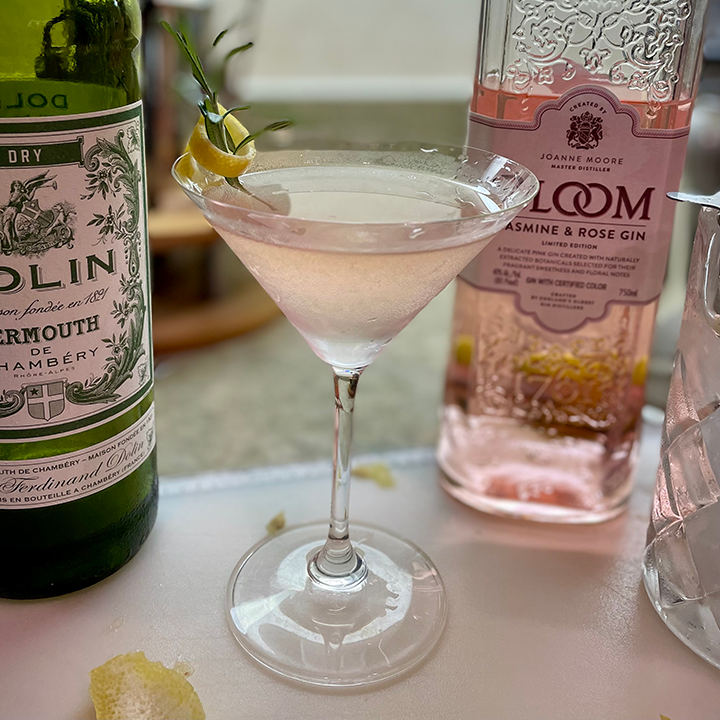
    The “Blooming Elegance” cocktail combines the sophistication of a classic martini with the delicate flavors of an English garden. The star of this show is the Bloom Jasmine & Rose Gin, a botanical masterpiece that infuses the spirit with the enchanting aromas of roses and jasmine. Complemented by a touch of Tito’s Vodka for smoothness, St. Germain Elderflower Liqueur for a subtle sweetness, and Dolin Dry Vermouth for balance, this cocktail is a symphony of floral notes that dance on the palate. A hint of lemon juice brightens the ensemble, creating a refreshing and well-rounded drink.

    Blooming Elegance

    – 2 oz. Bloom Jasmine & Rose Gin

    – 1/2 oz. Tito’s Vodka

    – 1/2 oz. St. Germain Elderflower Liqueur

    – 1/2 oz. Dolin Dry Vermouth

    – 1/8 oz. Lemon Juice

    Stir all ingredients on ice. Strain into a chilled martini glass. Garnish with a twist of lemon peel and a sprig of rosemary. 🍸

    Smoked Salmon Canapés

    Food Pairing Recommendations

    The “Blooming Elegance” cocktail’s floral and aromatic profile makes it an excellent companion to light and fresh dishes. Consider pairing it with a goat cheese and watercress salad, smoked salmon canapés, or even a platter of sushi with delicate fish flavors. The cocktail’s nuanced taste will complement the subtle notes of these dishes, creating a harmonious dining experience.

    A Brief History of the Martini

    The martini, a cocktail that has stood the test of time, has a history as rich and varied as its recipes. Originating in the late 19th century, the martini’s precise origins are somewhat disputed. Some credit bartender Jerry Thomas with its creation, while others trace its roots to the Knickerbocker Hotel in New York City.

    Traditionally made with gin and dry vermouth, the martini’s popularity soared during the Prohibition era, where gin became the spirit of choice due to its ease of production. Over the years, the martini has evolved, with variations incorporating vodka, different vermouths, and a myriad of garnishes.

    The “Blooming Elegance” cocktail not only pays homage to the classic martini but elevates it to new heights with the infusion of floral notes from the English garden. As you sip on this refined concoction, you’re not just enjoying a drink; you’re experiencing a symphony of flavors that transcends time and tradition. Cheers to the evolution of the martini and the endless possibilities that unfold in the world of mixology!