Bordeaux is a timeless elixir of history, terroir, and tradition. It’s a name that resonates with wine enthusiasts worldwide and is synonymous with excellence in winemaking. Nestled along the serene banks of the Garonne River in southwestern France, the Bordeaux wine region is a hallowed ground for cork dorks ;), boasting a rich history, distinct terroirs, and a complex classification system that sets it apart as one of the world’s foremost wine-producing regions.
A Glimpse into Bordeaux’s Enigmatic Past
Bordeaux’s history as a wine-producing region dates back to Roman times when the first vineyards were planted. However, it was during the 12th century, under the rule of Eleanor of Aquitaine and her marriage to Henry II of England, that Bordeaux wines gained international recognition. The English became avid consumers of Bordeaux wines, creating a demand that laid the foundation for Bordeaux’s global reputation.
“…you are not to conclude I am a drinker. My measure is a perfectly sober 3 or 4 glasses at dinner, and not a drop at any other time. But as to those 3 or 4 glasses I am very fond.”
Thomas Jefferson
During the 17th century, Dutch engineers drained the marshlands and introduced a more systematic approach to winemaking, paving the way for Bordeaux’s vineyards to thrive. In the 18th century, Thomas Jefferson, the third President of the United States, became an ardent admirer of Bordeaux wines, further elevating their prestige. I had the opportunity several years ago to ogle over (look but don’t touch) two bottles from Jefferson’s collection. The bottles were locked inside a wire cage, covered in dust, each donning a small white price tag–$20,000.
Left Bank vs. Right Bank: A Tale of Two Terroirs
One of the key distinctions in Bordeaux lies in its geographical diversity, which results in two distinct terroirs: the Left Bank and the Right Bank. Here is the breakdown…
Left Bank
– Located to the west of the Gironde Estuary and the Garonne River.
– Predominantly features Cabernet Sauvignon as the dominant grape variety.
– Famous appellations include the Médoc, Pauillac, Margaux, and Saint-Julien.
– Produces wines known for their structured, tannic character and aging potential.
Right Bank
– Situated to the east of the Gironde Estuary and the Dordogne River.
– Merlot is the primary grape variety, complemented by Cabernet Franc and sometimes Malbec.
– Renowned appellations include Saint-Émilion and Pomerol.
– Produces wines characterized by their elegance, supple texture, and approachability in their youth.
Bordeaux Region in Southwest France
Bordeaux’s Classifications: A Pyramid of Prestige
Bordeaux boasts a complex classification system, which adds an extra layer of intrigue to its wines. The most famous classifications include:
1. Bordeaux AOC:
– The base level of classification, offering wines that showcase Bordeaux’s classic characteristics.
– These wines can come from anywhere within the Bordeaux region and are typically approachable and affordable.
2. Bordeaux Supérieur AOC:
– A step above the Bordeaux AOC, with stricter quality control standards.
– Often produced from older vines, resulting in more concentrated flavors.
3. Médoc and Graves Classifications:
– Within the Médoc and Graves regions, several châteaux are classified as Cru Bourgeois or Cru Artisan, signifying wines of consistently high quality.
4. Saint-Émilion Classification:
– Saint-Émilion has a unique classification system that is revised periodically.
– It includes three main categories: Grand Cru Classé, Premier Grand Cru Classé “B,” and Premier Grand Cru Classé “A.”
– These classifications indicate the quality and prestige of the wineries.
5. 1855 Classification of the Médoc:
– Arguably the most famous classification in Bordeaux, it was established for the Exposition Universelle de Paris.
– Divided into five growths or “crus,” with the Premier Cru being the highest tier.
– Châteaux such as Château Margaux and Château Latour hold this esteemed title.
The complete list of all five first growths include:
Bordeaux’s intricate classification system reflects the region’s unwavering commitment to maintaining the quality and reputation of its wines.
Bordeaux’s allure lies in its rich history, diverse terroirs, and complex classification system. Whether you’re sipping a bold Cabernet Sauvignon from the Left Bank or enjoying the velvety embrace of a Merlot-based wine from the Right Bank, Bordeaux offers a wine experience like no other. Its journey from ancient Roman vineyards to its present-day global prestige is a testament to the enduring artistry and craftsmanship of Bordeaux winemakers. With each bottle, Bordeaux encapsulates centuries of tradition, making it an enduring and timeless elixir for wine lovers around the world.
In the illustrious world of fine wines, few names evoke as much reverence and admiration as Chateau Margaux (my favorite first growth). Nestled in the heart of Bordeaux’s famed Margaux appellation, this historic estate has consistently produced wines of unparalleled grace and distinction. Among the numerous exceptional vintages that have emerged from its cellars, the 1977 Chateau Margaux stands as a shining example of Bordeaux’s timeless elegance and the estate’s unwavering commitment to excellence.
During a routine gathering of five wine-loving couples–appropriately named Club 10–one particular label stood out. While it isn’t unusual for wine-enthusiasts Brian and Erin Toung to share rare and unusual wines from their extensive collection, we knew right away that this night was going to be special. All of the wines were spectacular, and the 1977 Chateau Margaux provided by the Brian and Erin Toung lived up its reputation.
Club 10 – August 18, 2023 at the home of Mike and Patti Weber
History of Chateau Margaux
Chateau Margaux’s legacy dates back to the 12th century when the property was first cultivated as a vineyard. However, it wasn’t until the 17th century that it began to gain prominence under the ownership of the Marquise de la Colonilla. Under her careful stewardship, Chateau Margaux rose to prominence, earning the moniker “The Pearl of Bordeaux.”
Throughout its storied history, the estate has changed hands several times but always maintained its reputation for producing some of the world’s finest wines. The modern era ushered in a new era of precision winemaking under the guidance of André Mentzelopoulos, and later, his daughter Corinne Mentzelopoulos, who continues to oversee the estate today.
The 1977 Vintage: A Snapshot in Time
The 1977 Chateau Margaux vintage occupies a unique place in the estate’s annals. While not as legendary as some of the earlier vintages, such as the 1961 or the 1982, it remains a fascinating chapter in Chateau Margaux’s history. This vintage was marked by a temperate growing season with a mild summer, resulting in wines that exhibit a graceful finesse rather than raw power.
Tasting Notes from a Sommelier’s Perspective
The cork quickly disintegrated during several attempts to release it from its stable home of 46 years. After a slow ritual-like decanting, it was time to indulge 😉
Aroma: Upon pouring a glass of the 1977 Chateau Margaux, I was immediately greeted by a symphony of aromas. Delicate notes of dried flowers, violet, and rose petals danced alongside more profound scents of blackcurrant, plum, and cherry. The bouquet was enchanting and seductive, showcasing the wine’s maturity with grace.
Palate: On the palate, the wine continued to captivate with its finesse. The tannins had softened over the years, providing a silky texture that caressed the tongue. While the fruit had mellowed, it remained vibrant, revealing flavors of blackberry, cedar, tobacco, and subtle hints of leather. There was a lovely balance between the fruit and tertiary notes, making it a delight to savor.
Structure: The 1977 Chateau Margaux maintained an impeccable structure. It had a medium body with a long, elegant finish that leaves a trail of subtle spices and a touch of minerality. The wine’s acidity was still remarkably fresh, providing a sense of vitality that belies its age.
Pairing: This vintage calls for equally refined and nuanced cuisine. It paired perfectly with the French-inspired dishes meticulously prepared by our Club 10 hosts, Mike and Patti Weber. The wine’s elegance and complexity complemented these dishes beautifully.
An Experience Like No Other
The 1977 Chateau Margaux is a testament to the timeless allure of Bordeaux’s Margaux appellation and the unwavering commitment to quality at Chateau Margaux. While it may not be the most famous vintage from this legendary estate, it offed a unique opportunity to experience the grace and finesse that have made Chateau Margaux a household name among wine connoisseurs. With its mature aromas, silky palate, and impeccable structure, the 1977 Chateau Margaux continues to captivate the senses and remind us of the enduring excellence that defines this historic winery. Thanks Brian and Erin!
Few grape varieties offer as much versatility and expressive potential as Chardonnay. Within the Vitis vinifera family, it stands as one of the most adaptable varietals—capable of producing everything from zesty, mineral-driven wines to rich, barrel-aged expressions. Winemakers often call it the “blank canvas” grape, not because it lacks character, but because it reflects the sum of choices made in the cellar: oak or stainless steel, malolactic conversion or crisp acidity, extended lees aging or youthful freshness. Chardonnay mirrors technique—and that is precisely why professionals revere it.
The name Chardonnay originates from a small village in the Mâconnais subregion of Burgundy, France. While legends once traced its ancestry to medieval crusades or poetic tales from Cyprus, modern science has provided a far clearer understanding.
Thanks to genetic research—most notably by Dr. Carole Meredith of the University of California—we now know that Chardonnay is a natural cross between Pinot Noir and Gouais Blanc. That lineage is meaningful: Pinot Noir has long been considered the noble grape of Burgundy, while Gouais Blanc was historically grown for everyday table wine. Their close proximity in vineyards centuries ago allowed for cross-pollination that ultimately produced the varietal we recognize today.
Interestingly, Gouais Blanc has been known by more than 140 different names—proof of its widespread cultivation—and yet it has all but disappeared today. Chardonnay, on the other hand, has become one of the most celebrated and widely planted grapes in the world.
Chardonnay and Terroir: A Natural Translator
Chardonnay is uniquely sensitive to terroir—the combination of soil, climate, altitude, water access, and topography that shape a wine’s character. For this reason, many Old World labels emphasize geographic origin more than grape variety.
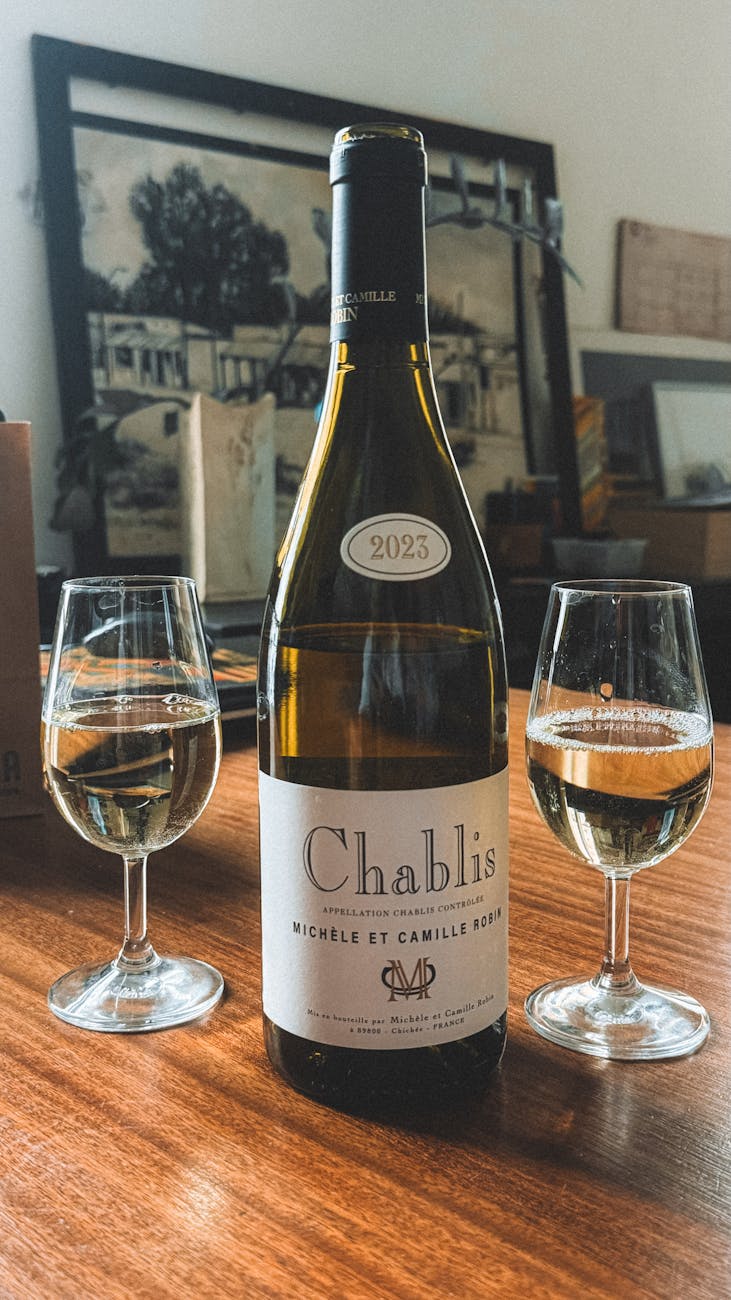
Take Chablis, for example. It is not a synonym for Chardonnay, yet every wine labeled Chablis must be made from Chardonnay. The region’s cool climate and Kimmeridgian limestone soils produce wines that are lean, flinty, and mineral-driven—quite different from the fuller styles of, say, Sonoma or Margaret River. Thus:
All Chablis are Chardonnay, but not all Chardonnays are Chablis.
Gregory Dean, SOMM&SOMM
In Burgundy’s Côte de Beaune, names like Montrachet (pronounced “Mon-ra-shay”) represent some of the most prestigious—and expensive—Chardonnays on earth. Further south, Pouilly-Fuissé in the Mâconnais region is known for producing ripe, elegant Chardonnays that balance fruit with structure. Nearly every Old World country—France, Italy, Spain, Germany, Austria, Portugal, Greece, Hungary, Croatia, and others—produces unique expressions shaped by specific terroir.
Old World generally refers to European, Middle Eastern, and North African wine-producing countries.
New World Chardonnay: Sunshine in the Glass
In contrast, New World regions such as California, Australia, South Africa, Chile, and Argentina typically experience warmer growing conditions. More sunlight means longer hang time, which increases sugar levels in the grapes. Higher sugar translates into higher alcohol during fermentation—one reason New World Chardonnays tend to be richer, fuller-bodied, and more fruit-forward.
These subtle temperature differences allow either the fruit or the influence of oak and lees to take the spotlight.
What About ‘Buttery’ Chardonnay?
The often-discussed buttery texture comes from malolactic conversion—a natural process where sharper malic acid (like that in green apples) is transformed into softer lactic acid (found in milk and cream). This adds texture and roundness while reducing acidity. Not all winemakers choose this technique; some prefer the crisp purity of a non-malo Chardonnay. Again—the grape simply mirrors the choice.
Chardonnay is also one of only three permitted grapes in Champagne—the sole white varietal allowed. In fact, when you see Blanc de Blancs on a Champagne label, it indicates the wine is made from 100% Chardonnay. Its elegance and aging potential make it highly prized in sparkling wine production around the world.
Stylistic Tools of the Winemaker
Chardonnay can express a wide range of styles depending on the methods used:
Stainless steel fermentation – preserves freshness and acidity
Oak aging – adds spice, texture, and complexity
Concrete eggs – enhance mouthfeel without imparting flavor
Malolactic conversion – softens acidity and adds creaminess
Lees stirring (bâtonnage) – contributes body and aromatic depth
Chardonnay, perhaps more than any other grape, tells the story of the cellar.
Too many to list—but each one showcases a different voice of the same grape.
A Final Thought
The best way to understand Chardonnay is to taste it across regions, styles, and techniques. In a gallery, we use our eyes to interpret a painting. With wine, we have the luxury of using three senses instead of one—sight, smell, and taste. Each glass reveals the winemaker’s intention and the land’s identity.
Next time you pour a Chardonnay, ask yourself: What story is the winemaker telling… and what is the vineyard whispering in the background? Cheers ❤️
Edited: Original post was written and published 2/18/2023. Refreshed and updated 11/29/2025
While many (or most) individuals choose a wine education and certification path specific to their goals–such as hospitality/service, consultant, distributor, etc.–I thirst for a broad yet detailed knowledge of all things wine. So, it just makes sense to add the award-winning WSET courses and curriculum to my perpetual wine-knowledge-seeking journey 😉
The Wine & Spirit Education Trust (WSET) offers four wine-focused courses and qualifications–including WSET Level 1 Award in Wines, WSET Level 2 Award in Wines, WSET Level 3 Award in Wines, and the prestigious WSET Level 4 Diploma in Wines. As expected, each subsequent course is more demanding than its predecessor. From the very first level, individuals are introduced to a systematic approach to tasting and evaluating wine. Throughout all the courses, this approach evolves into a very important methodology required for successful blind-tasting during the exams and beyond.
Having first-hand knowledge of the tasting science taught by The Society of Wine Educators and the deductive tasting methodology of The Court of Master Sommeliers, I can appreciate the sometimes-not-so-subtle differences between these two and WSET’s Systematic Approach to Tasting (SAT). WSET’s approach to tasting is easier to grasp than the others, but they all use the same three core steps–individually describe and evaluate the wine by sight, smell and taste.
I chose the Napa Valley Wine Academy for my WSET courses. While there are several options, I liked the reputation of this organization. The WSET Level 2 Award in Wines course was online (also available in person), and fit my busy schedule. The online course consists of a five-week structured program including four live video conferences with an instructor. Traditionally, at the conclusion of the five-week program, you sit for a proctored timed exam. The student has one hour to answer 50 questions. The exam questions reinforce the information learned during the previous five weeks. For me, however, the timing between course completion and exam was greatly compressed.
While selecting all of the options during enrollment, and thinking the course was “self-paced,” I scheduled the exam with ProctorU roughly two-and-a-half weeks from my start date. So… as soon as the course materials arrived I began. Just after the second week, I sat for the exam 🙂
Now… onto Level 3 (10-week course). Only this time it is a requirement to take the exam in-person. Cheers!
There is no better way to learn about (and appreciate) wine than to get fully immersed in its rich history, culture, and traditions. Sometimes we get so involved in studying a wine’s properties–such as nose, taste, structure, and color–that we miss out on the characteristics that make the wine unique to a particular country, region or village. This is especially true for the less traveled old-world vineyards and wineries of Eastern and Central Europe. We recently participated in a traditional Georgian supra (სუფრა) and experienced a full day of traditional dishes, wine, toasts (many toasts) and Georgian culture complete with our own tamada (თამადა).
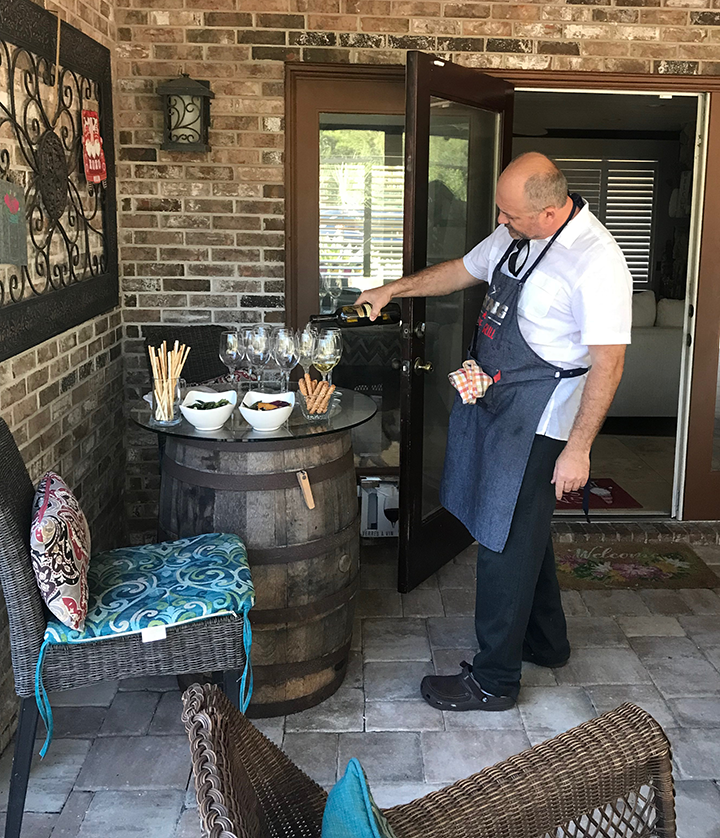
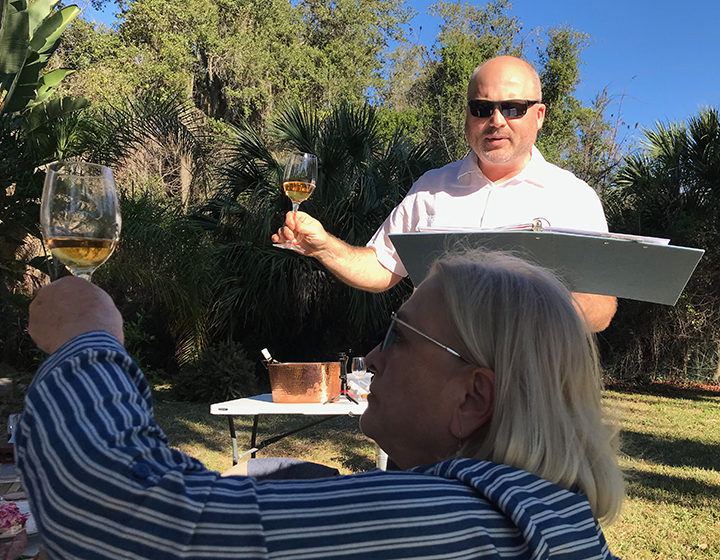
Our tamada, Dima, pours our first Georgian wine of the afternoon
Upon arrival, we knew right away that Dima and Oksana (our hosts) had meticulously planned an afternoon of wine, food and education to challenge our minds and stimulate our senses. Other than the high-level information about viticulture and vinification from our somm-studies, we knew very little about the history and culture of Georgian wines. That was about to change 😉
Our tamada, Dima, poured the first wine (2018 Marani Tsinandali) as we watched several very informative videos. Tsinandali is a dry white wine from the region of Kakheti. Although a blend of Rkatsiteli (80%) and Mtsvane (20%), it had a familiar nose. On the palette, the creaminess from being aged a short time in oak barrels reminded me of a Chardonnay. The tropical fruit notes, however, were reminiscent of a Pinot Grigio.
The closest match (at least to my palette) would be the Marsanne-Roussanne blends of Rhone, France–such as the Domaine Jean-Louis Chave Hermitage Blanc. While sharing a few characteristics of other dry white wines, this Tsinandali was truly unique and the perfect way to start our journey of Georgian wines.
Our wine-fueled discussions continued with a deep dive into the Country of Georgia and its long history of producing wine. Winemaking in Georgia can be traced back to the people of South Caucasus in 6,000BC. That’s right… archaeologists have uncovered clay wine vessels (called qvevris) that date back 80 centuries. With a basic understanding, and whole new appreciation for Georgia, we’re ready for our tamada-led supra–Gaumarjos!
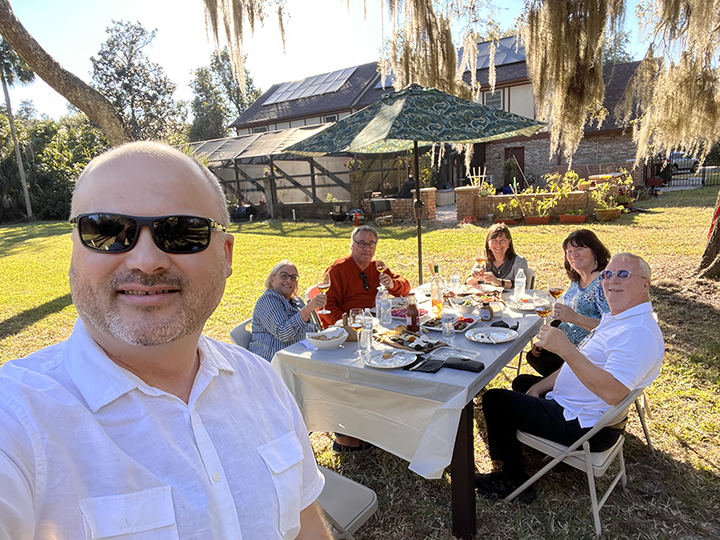
From left to right: Dima (our tamada), Tammy, Greg, Oksana, Patti and Mike
A Georgian keipi (ქეიფი) would not be authentic without a tamada to lead and lecture. Dima wasted no time in leading us through the first of many though-prevolking and purposeful toasts. Several were off-the-cuff as expected, but most followed the deep-seated tradition of the Georgian supra.
“To family, friends, health, long life and laughter…”
The table was covered with amazing regional-inspired dishes which paired perfectly with the Georgian wines. The second wine in the lineup was a crisp aromatic dry white Chinuri (Iago Chinuri) from the Mukhran Valley. This no-skin-contact wine had a bright acidity and subtle minerality. Awesome!
The dry white wines of Georgia are really special. As with the Iago Chinuri, the next two (2) single-varietal wines are macerated in qvevris (also spelled kvevris). This ancient method of producing Georgian wine involves burying it underground for an extended period of time. In fact, it was the early Georgians that discovered grape juice buried in the ground for the winter would turn into wine. So, is Georgia the birthplace of wine? Hard to argue otherwise.
The third wine in the lineup was a single varietal traditional qvevri dry white Rkatsiteli from the Kakheti region (2017 Marani Rkatsiteli). It was nice to taste and enjoy this varietal stand-alone, and compare it to the previous blend (2018 Marani Tsinandali). The qvevri method gives this wine a very different profile. There was a hint of orange in the color (more like amber), but certainly not glowing neon like the California white wines that spend additional time on the skins.
The nose is intense and herbaceous. On the palette, this wine is very expressive. Some minerality exists, but the herb notes really come forward. This was a very nice wine, and really opened our eyes (and minds) to the lesser-known varietals. There are an astounding 500+ varieties of indigenous grapes in Georgia. Only 40 varietals are used in commercial production.
At this point, we were are all fully committed to the supra, and our tamada has led us through many toasts. Our wine glasses were never empty, as the discussions are focused on those special clay pots and their role in subterranean winemaking 😉
The fourth wine could not have been timed better. Smoked meats, specialty cheeses, deep-fried okra (my favorite), fresh bread, and a beet salad beyond words were perfect with this 2017 Marani Mtsvane. The qvevri orange wine was beautifully elegant with a long finish. The tannins, uncharacteristic in a white wine, were soft and smooth. Gaumarjos!
The 2017 Marani Mtsvane wine has forward notes of pitted fruits, and at the same time ripe melon lurks in the distance. I detected fruit tree blossoms on the nose. Generally speaking, amber/orange wines sacrifice fruitiness for tannins by spending up to six months on the skins. This particular wine, however, had the brightness of a white and the soft tannins of a red. Perfect springboard to the Georgian red wine lineup.
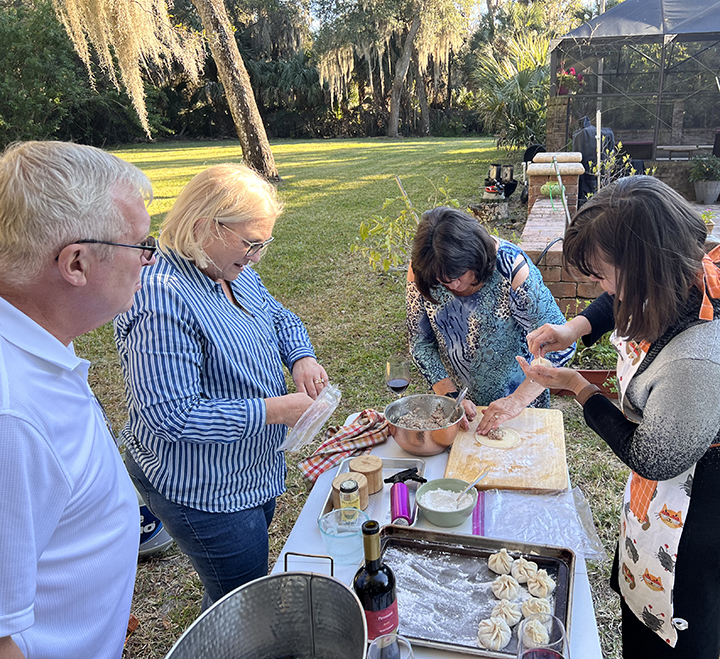
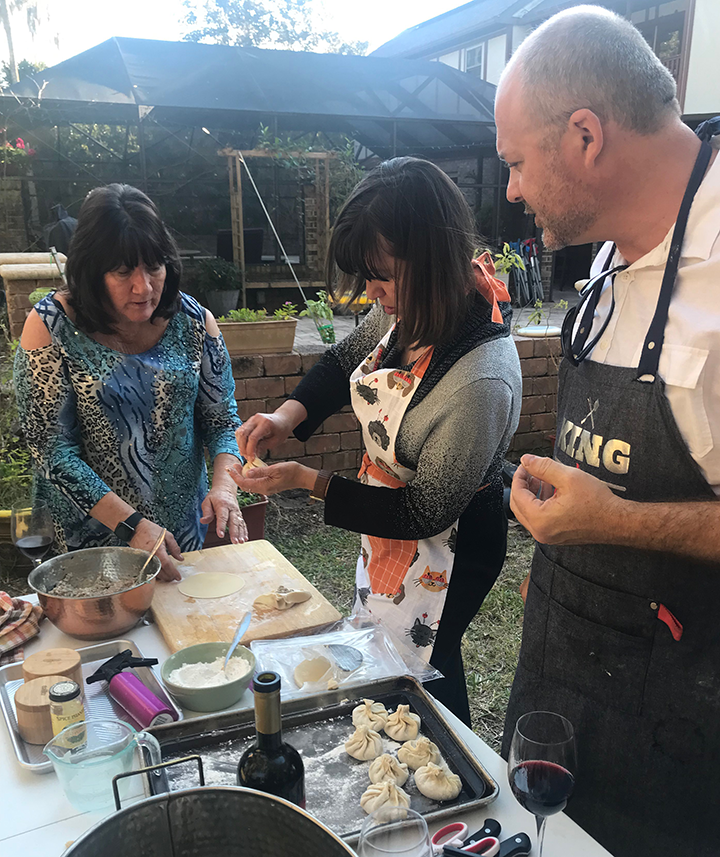
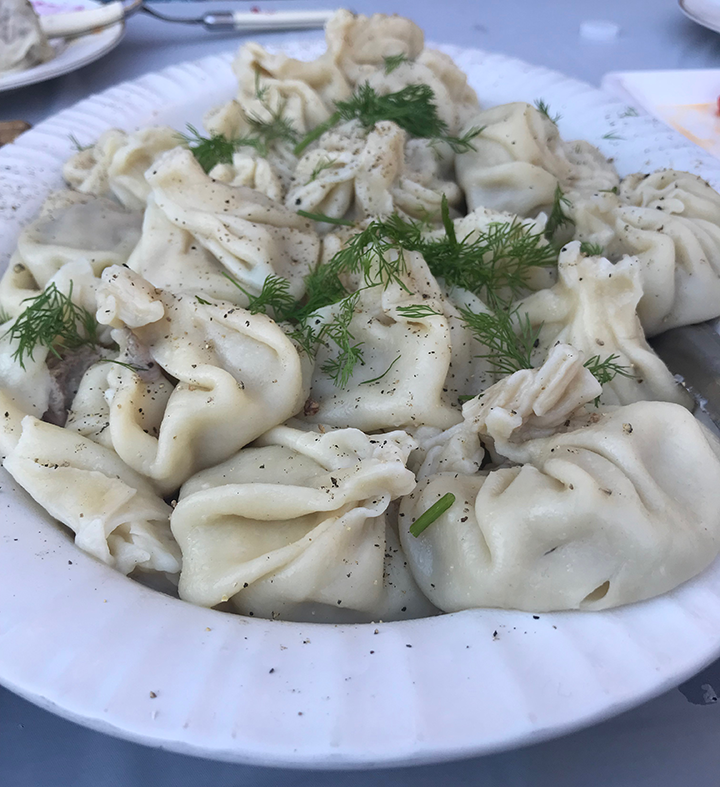
The time had come for a lesson in the art (and science) of making khinkali (ხინკალი). This giant dumpling–sometimes spelled ‘hinkali’–is thought to have originated in Georgia. Regardless, it is still a mainstay. Oksana taught Tammy, Patti and Mike the proper technique for filling and forming these delicious dumplings. Dima feverishly stirred a huge pot of seasoned boiling water and cooked the khinkali to perfection.
As we moved into the entrées, it was time to abandon the wonderfully intriguing white wines of Georgia and explore the world of expressive reds. The next two (2) wines were a great introduction into one of the most common varietals in Georgia–Saperavi.
First up (fifth in the lineup for those keeping score) was the 2016 Damani Saperavi. Initial impression was that this wine was faulty. It was somewhat bitter and unapproachable. After a few minutes, it began to resemble wine. Eventually the characteristics of a Saperavi varietal started to come through. Slightly smoky and light floral notes. Still a little bitter and acidic for this varietal.
This is only my third teinturier grape variety I’ve had the opportunity to taste. The other two were Gamay de Bouze and Chambourcin. Teinturier grapes have dark skins and dark flesh/pulp. Most red varietals have dark skins and clear flesh.
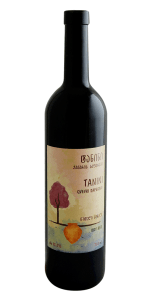
The sixth wine–also a Saperavi–was a 2019 Tanini Saperavi from the Kakheti region. This wine had an intense inky color typical of teinturier varietals. This unoaked red wine was surprisingly well-structured and balanced. The dark, ripe fruits and just the right amount of earthiness was perfect for what was next–lamb skewers.
The contrast between the 2016 Damani Saperavi and 2019 Tanini Saperavi wines was unexpected. Especially since both wines were produced in the same area (region). This cold-tolerant varietal is gaining momentum in the northeastern United States–notably in the Finger Lakes.
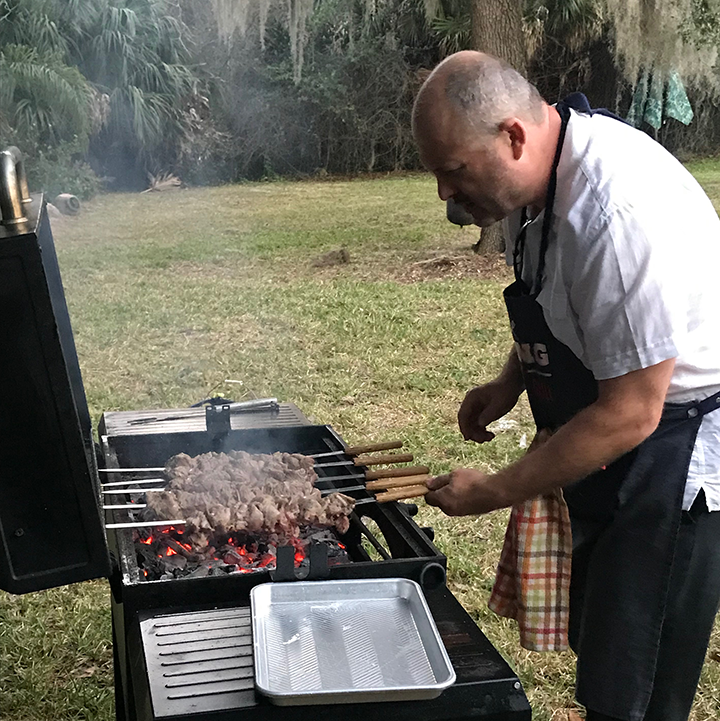
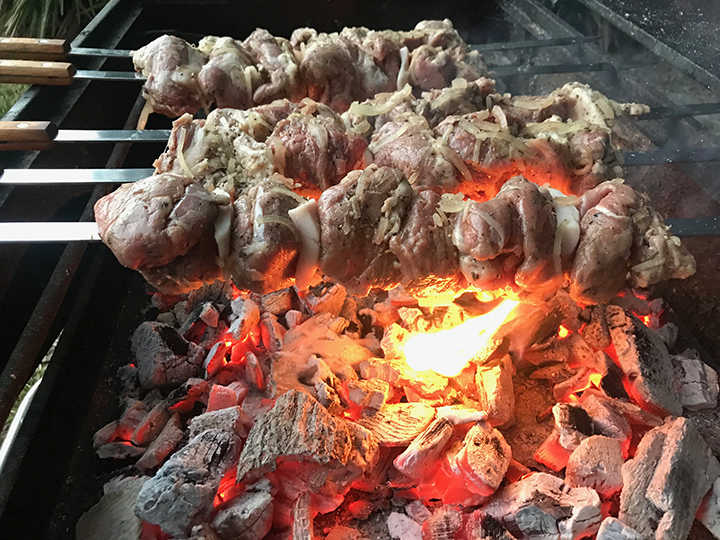
A few glasses into the red wines was the perfect time for the pièce de résistance. With a few bold Georgian reds next up on our journey, we were excited to try each paired with Dima’s char-grilled lamb skewers and the plethora of Oksana’s accompanying dishes. Gaumarjos!
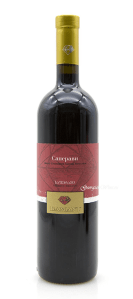
Mukuzani is an area in Kakheti where they are only allowed to make dry wines from 100% Saperavi grapes. The seventh wine in our lineup, a 2018 Marani Mukuzani, was very charismatic. The nose was chocolate-covered cherries and vanilla spice (yes… in the same glass). This wine is dry and very well balanced. Perfect with the Georgian cuisine!
Unlike the two previous Saperavi wines, this Mukuzani was characteristic of old-world reds. The oak aging combined with the use of qvevris gently coax flavors of ripe, juicy fruit and prunes from the Saperavi grapes. Qvevris are buried in dirt cellars called ‘Marani,’ so it makes sense to name a company the same 😉
Mukuzani is 1 of 24 Protected Designations of Origin (PDO) wine appellations in the Country of Georgia. Each appellation concentrates on one main wine style (dry red, semi-sweet red, dry amber, sweet amber/fortified white, dry white, semi-dry white, semi-sweet white, sparkling white).
The eighth wine (whew) of our journey was a 2019 Marani Kindzmarauli. Kindzmarauli is an appellation that produces semi-sweet red wines. The Marani Kindzmarauli was very silky, and unlike the Mukuzani had more distinct blackberry and ripe cherry notes. The wine was expressive and bright. This is undoubtedly due to the wine being finished in stainless steel tanks as opposed to oak barrels.
Kindzmarauli is considered semi-sweet and certainly would have seemed sweeter if served slightly chilled. It was perfect with the grilled meats and rich dishes of our supra. Having the opportunity to experience all of the facets of this varietal was special… and very enlightening.
The ninth wine in the lineup was another semi-sweet red from the Kindzmarauli PDO. Our tamada opened a very special 2019 Teliani Valley Kindzmarauli late harvest wine. We typically associate late harvest with dessert wines. We’ve recently discovered, however, that semi-sweet Georgian wines would be considered not-so-sweet or semi-dry in other countries.
Tannic and flavorful. Dark fruit, spices and mocha on the nose. This wine stood up to the many flavors of our feast. The most interesting thing about the semi-sweet wines of Georgia is how perfectly balanced (and very unusual) to have tannins present. It works… and it works well. Gaumarjos!
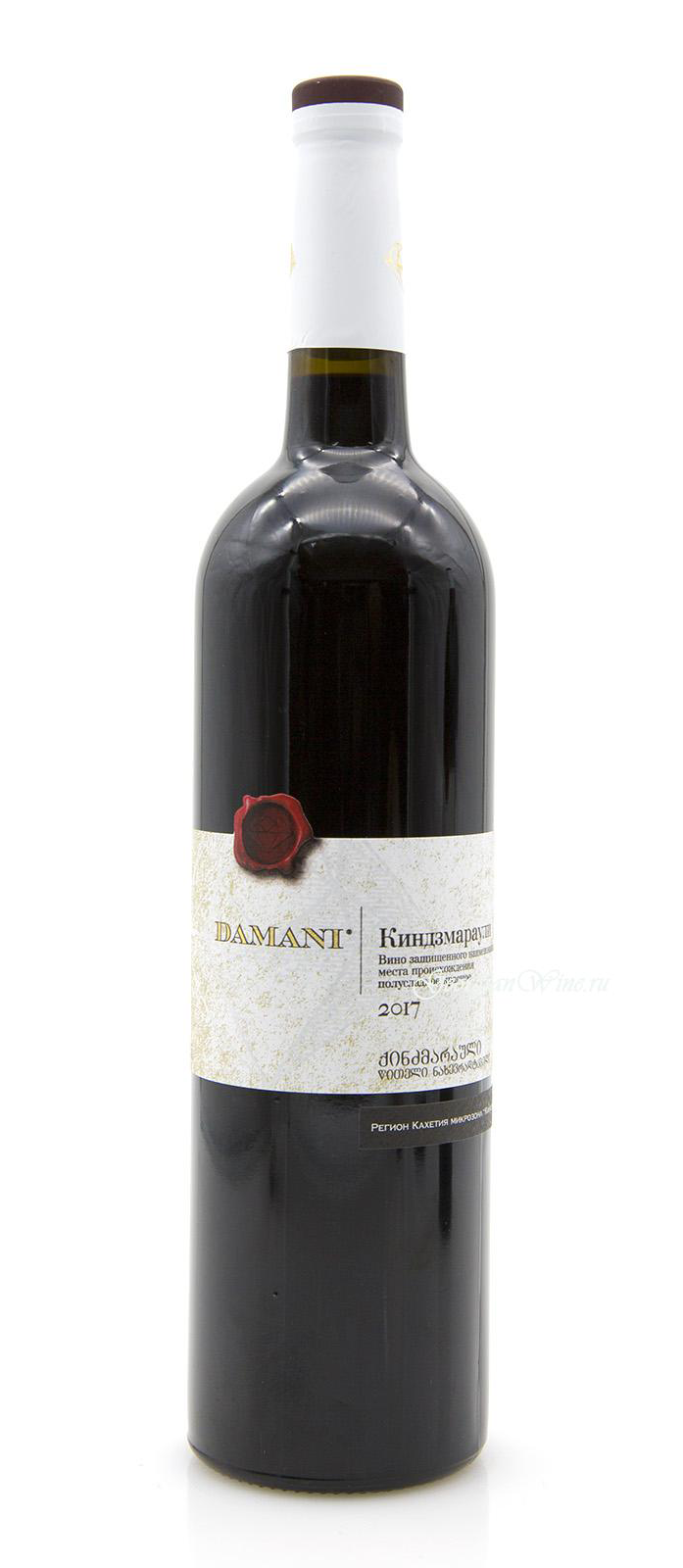
The supra was rounded out by two amazing semi-sweet Georgian wines. Wine number ten in our lineup was a 2017 Damani Kindzmarauli. This wine stood on its own, although it was right at home with the Georgian fare. It was a little different than the other Saperavi wines of the tasting. For me, at least, it reminded me of a well-balanced red blend.
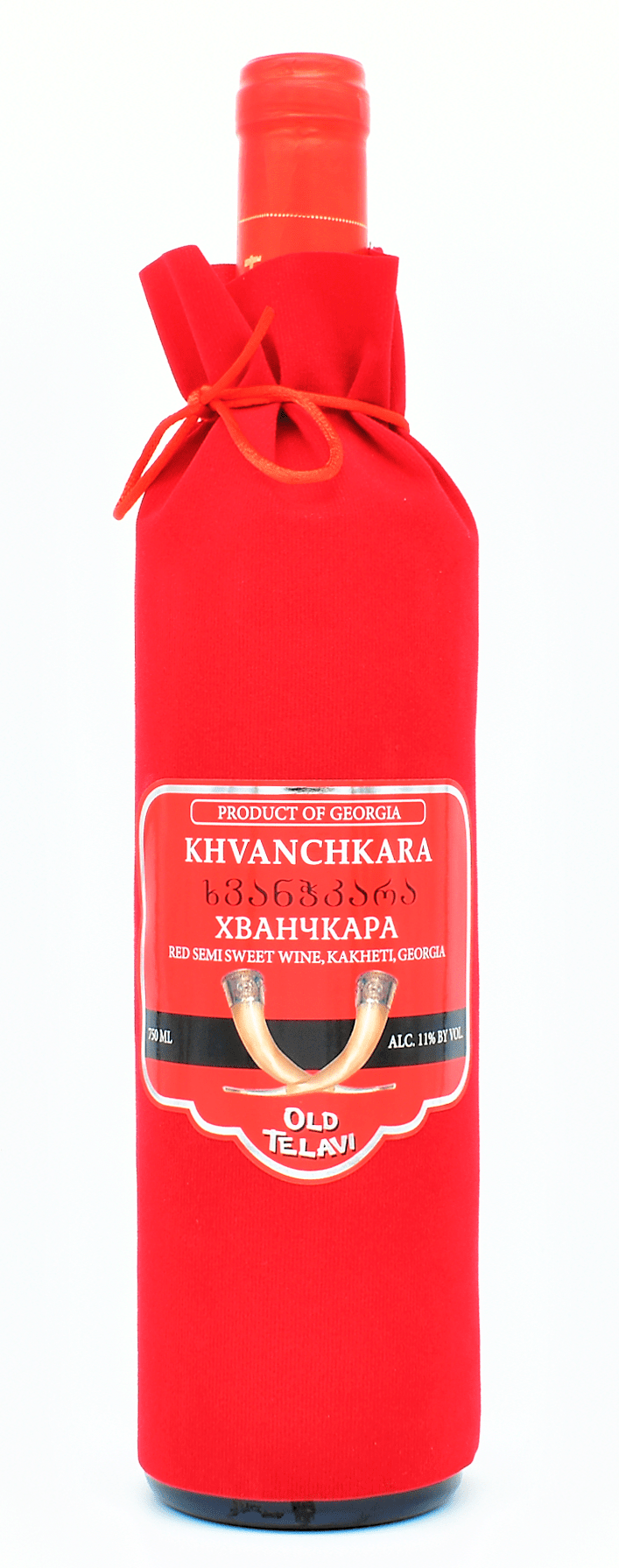
The eleventh and final wine of the supra was a perfect closer. The Old Telavi Khvanchkara red dessert wine was absolutely amazing! Made from a blend of Aleksandrouli and Mujuretuli grapes, it was lush and balanced. Filled with blackcurrant and raspberry aroma, the wine is juicy and slightly tannic. Yes, please!
This was one of the most fun and educational gatherings we’ve ever attended. We all have a new appreciation for the Georgian traditions of drinking, toasting and feasting. Dima and Oksana were incredible hosts. Their passion for wine, culture and cuisine was on full display. Dima and Oksana’s masterful creations perfectly complimented the wines of Georgia and our tamada’s artfully prepared toasts.
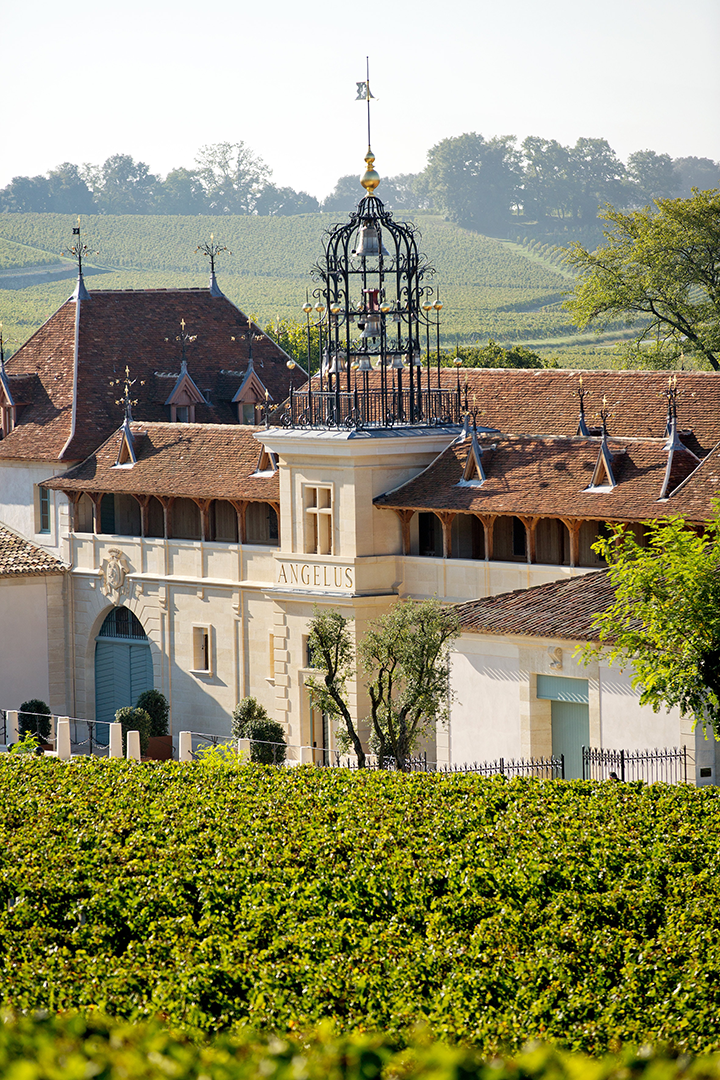
We had just barely finished celebrating the New Year when I first heard the news. In a very bold but predictable move, the famed Chateau Angélus withdrew from the 2022 Saint-Émilion ranking. Yep, in an instant… the volatile classifications of Saint-Émilion are again facing scrutiny. So, why all the drama?
Unlike the 1855 Classifications of Medoc and Graves on Bordeaux’s famed ‘Left Bank,’ the Saint-Émilion rankings are revisited approximately every 10 years. The last few reclassifications, however, have given way to public scrutiny and backlash from the wine community. While the idea of a constantly-evolving classification is noble, there is simply no way to avoid questions surrounding credibility when there is a clear conflict-of-interest.
“The optics alone screams controversy.”
-Gregory Dean
Hubert de Boüard, co-owner of Chateau Angélus, has been under fire for several years because of his participation in the national wine appellations committee. The optics alone screams controversy. In the very competitive world of wine, every advantage matters. I don’t believe, however, Hubert de Boüard was doing anything more than offering his many years of winemaking passion, experience and knowledge to help Saint-Émilion maintain the status and reputation it deserves.
The Saint-Émilion wine classification began in 1955–one hundred years after the very famous 1855 Bordeaux Classification–with the promise of revising status and standing every 10 years (or so). To date, there have been six classifications. The most recent was in 2012 and included eighteen First Grands Crus Classés. Four of the eighteen were First Grands Crus Classés A–including Chateau Angélus, Chateau Ausone, Chateau Chevel Blanc, and Chateau Pavie.
Currently (January 2022), Chateau Pavie is the only remaining Grands Crus Classés A estate from the 2012 classification. Chateau Ausone and Chateau Chevel Blanc withdrew in July 2021. It is an unfortunate fact that these classifications–as well as certain high-profile wine scores–influence popularity and pricing. Being elevated to the highest classification can instantly change a consumer’s perception of a particular Saint-Émilion chateau… but at the same time, a demotion to a lower classification can impact the winemaker’s bottom line.
That being said, the fact that these estates chose to distance themselves from the Saint-Émilion wine classification speaks volumes about how the benefits have become overshadowed by what has seemingly become a biased process. At least that’s what one court declared by fining Hubert de Boüard for his involvement in national wine appellations committee.
The evolving classification of Saint-Émilion will continue to motivate estates to maintain quality and consistency (that’s a good thing). Until tighter rules for regulating the classification process are implemented, it will remain the center of controversy in the ‘Right Bank’ of Bordeaux.
Wasting no time, I decided to jump right into the deep end of the wine-education pool. The study materials from our recent completion of The Court of Master Sommeliers – Introductory Course and Examination had just had time to cool down before a new set of study materials arrived. At first glance, I knew there was much to learn in preparation for the Certified Specialist of Wine (CSW) exam 😉
The Society of Wine Educators offer a variety of courses and exams leading to certifications for wine and spirits. The first step in my pursuit of a Society of Wine Educators Certified Wine Educator status is the highly respected Certified Specialist of Wine (CSW). The course collateral includes a textbook and workbook filled with information required to pass the 100-question timed exam.
With the holidays just around the corner, the study-time window is closing. The level of detail in the course materials goes well beyond the Court of Master Sommeliers Introduction Course and Exam—as expected. This will be no walk-in-the-park. Regardless, there is much to learn and it is all very fascinating.
I absolutely love the deep dive into the chemistry of wine, the nuances of viticulture and the most obscure wine regions of the world. This curriculum provides the level of detail you would expect someone who is preparing for a career in wine education to know. As with the previous courses, there are also requirements for tasting, evaluating and identifying wines. Here we go 😉
We’ve all spent many hours reading scores and reviews from some of the most well-respected wine aficionados in the world. In most cases, we align our tastes with the palette of one of these professional wine critics. I tend to lean more towards the tastes of Robert Parker than James Suckling, but both provide a peek into the characteristics and profile of even the most obscure wines.
There is no escaping the fact that a high score from one of the well-known critics will almost always boost demand. Personally, I have been known to seek out wines that have achieved a perfect score from either Robert Parker or James Suckling. Even before opening these wines, my expectations have been set. The wine should be incredible–almost life-changing. I don’t always agree with the ratings, but these scores have definitely had an impact on which wines I buy and which wines I avoid.
Tammy and I have decided to share our wine-centric wit and wisdom by introducing a new series–The Deans’ List. Before you English majors begin the barrage of comments, let me defend the plural possessive proper noun 😉 Our last name is Dean. Together, we are the Deans (plural). Our list of wines and evaluations–resulting from the SOMM&SOMM profile and analysis–is accurately named The Deans’ List (plural possessive). It also doesn’t hurt to have a natural play on a phrase associated with academic achievement.
Unlike the academic list… wines added to the SOMM&SOMM Deans’ List will include a Grape Point Average (GPA) based on the SOMM&SOMM approach to evaluating wines. Our methodology includes metrics important to consumers–such as pair-ability and share-ability. We are always interested in classic food and wine pairings, and will continue to expand on these ideas in our Perfect Pairings series. Other measurements–such as Old World or New World Characteristics, Effects of Climate, Effects of Geography and more–will provide a different (and hopefully useful) perspective into these wines.
Great wine isn’t cheap, and cheap wine can be good but rarely great 😉
-Gregory Dean 2021
Recognizing the fact that any given varietal can produce countless variations and seemingly endless styles, we think it’s important to rate wines on (1) how well they represent (e.g. stay true to) their terroir, (2) the balance and complexity, (3) the approachability and versatility, and (4) the overall value. You know… the stuff important to consumers. Great wine isn’t cheap, and cheap wine can be good but rarely great 😉 We hope to uncover some of these hidden gems.
Sample SOMM&SOMM Summary Card (not an actual evaluation)
Most of us naturally evaluate wine every time it hits our glass. It can be difficult, however, to evaluate wine objectively. Just because it’s not my favorite doesn’t mean it’s not a good representation of wines of the same style from the same region. The summary card for each wine provides a quick glance at all the usual characteristics plus an overlay of the average (typical) characteristics.
As part of our evaluation process, we will include details with recommendations for pairing and sharing. Our wine evaluation and overall analysis will ultimately lead to a Grape Point Average (GPA). A 4.0 Grape Point Average is the highest possible score, and reserved for wines that best represent wines of the same varietal, region, and style.
Be sure to subscribe to this blog and be the first to receive notifications when new wines are added to the SOMM&SOMM Deans’ List 😉
The best things happen outside your comfort zone. The first few months of this journey left Tammy and me mentally exhausted, but at the same time energized. Keeping this journey of oenology and viticulture a secret was an enormous challenge. Every interaction with our friends and family was an opportunity to reveal our plans, but somehow we kept it under wraps–at least for a minute or two 😉 One reason to keep it hush hush was to save ourselves from embarrassment in the event something went terribly wrong.
We have attended (and hosted) many wine-centric events over the past fifteen months–during which time we shared some incredible wines paired with amazing cuisine–all contributing to our journey from enthusiasts to sommeliers. Our friends’ and family’s shared passion for wine was the inspiration needed to forge ahead with the first-step to becoming a certified sommelier. We are, in fact, eternally grateful to everyone who knowingly and unknowingly contributed to our success.
Special thanks to Scott and Alison White
Our friends Scott and Alison White have made us feel like there was nothing we couldn’t accomplish with a little hard work, and a lot of liquid courage (wine). Scott blazed the trail by being the first to jump into the deep-end of the wine knowledge pool. We embrace every opportunity to participate in his relentless pursuit of the perfect wine pairing dinner. We are in awe of his extensive collection of wine, and have cherished every moment of traveling, dining, and attending events with Scott and Alison.
Special thanks to Dima and Oksana Semenski
Dima and Oksana are responsible for our involvement in several local wine enthusiast clubs. They are good friends, gracious hosts (see Wine Experiences: A Taste of Adelsheim), and natural oenologist with a passion for robust old world reds and obscure whites. From the first time we met–at a local wine bar–to the many wine-related events and special occasions, Dima and Oksana have shared our love of wine and appreciation of wine knowledge.
Special thanks to Mike and Patti Weber
Mike and Patti are without a doubt two of the most fun-loving, life-embracing people we’ve ever met. We feel fortunate to be on their exhaustive list of friends. There have been countless events in their home–including Wine Experiences: The Debate–and each one somehow rivals past events. This is also true with casual get-togethers and spontaneous outings, where there are usually a bottle or three of Bordeaux making its way to our glasses 😉
While it is important to note that I am now on a first name basis with the FedEx guy–because of all the hard-to-find wines we’ve acquired and tasted along the way–the two local venues (95 and Vine and The Chalice Off Canal) played an important part in our journey. These wine bars both provided sanctuary and much needed escape from the textbooks. Not to mention an amazing selection of wines and wine-friendly food. Yes, please.
As mentioned in the title, this is just the beginning. There is so much to learn (and appreciate) as it relates to oenology and viticulture, it can truly be never-ending (in a good way). The Court of Master Sommeliers online courses were organized very well, and the instructors were engaging and professional. While not the same experience as the in-person Introductory Sommelier Course & Examination, we definitely gained tremendous knowledge. I’ve already started researching enrollment in the next level CMS course, as well as Wine & Spirits Education Trust (WSET) courses.
What started out as a very clear path to sommelier-hood was quickly disrupted by the pandemic. This week, however, begins our final countdown to completing the Introductory Sommelier Course & Examination. If you’ve followed the journey, beginning with Enthusiast to Sommelier: Getting Started, you quickly realize how self-study followed by a two-day course and examination turned into a fifteen-month marathon. Sometimes it seemed more like a fifteen-month rollercoaster 😉 Fortunately, there was wine. Lots of wine!
The past few months have been non-productive. Summer is the time to enjoy the easy breezy lifestyle of casual get togethers and family gatherings. And while many (ok… all) of these events involved wine, it didn’t involve wine education. With the exception of several wine-themed events–such as tastings and food/wine pairings–very little progress was made towards preparing for the exam. All of that changed this week as we begin the final countdown.
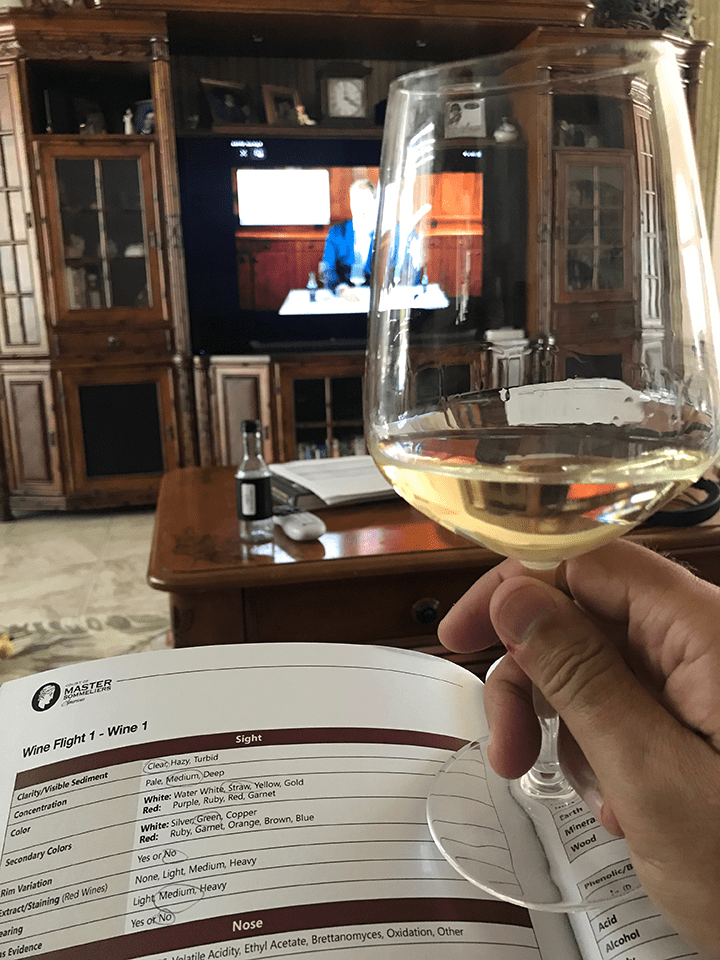
We began the week with a bing-watching day of online classes hosted by various Master Sommeliers of The Court of Master Sommeliers. Then we each took six practice exams to get an idea of where we need to concentrate our studies. As expected, recalling most of the information about major wine regions was second nature. This was definitely not the case with the more diverse regions (e.g. Loire Valley). For the next four evenings, we will be diving deep into these challenging regions. If all goes well, we will have completed the course and examination by this time next week.











 SOMM&SOMM
You must be logged in to post a comment.